Rate: Complete set of chakra tuning forks
Enquiry regarding: Complete set of chakra tuning forks
Complete set of chakra tuning forks





Complete set of chakra tuning forks
€ 185,00
€ 185,00
Description
Tuning forks: an explanation
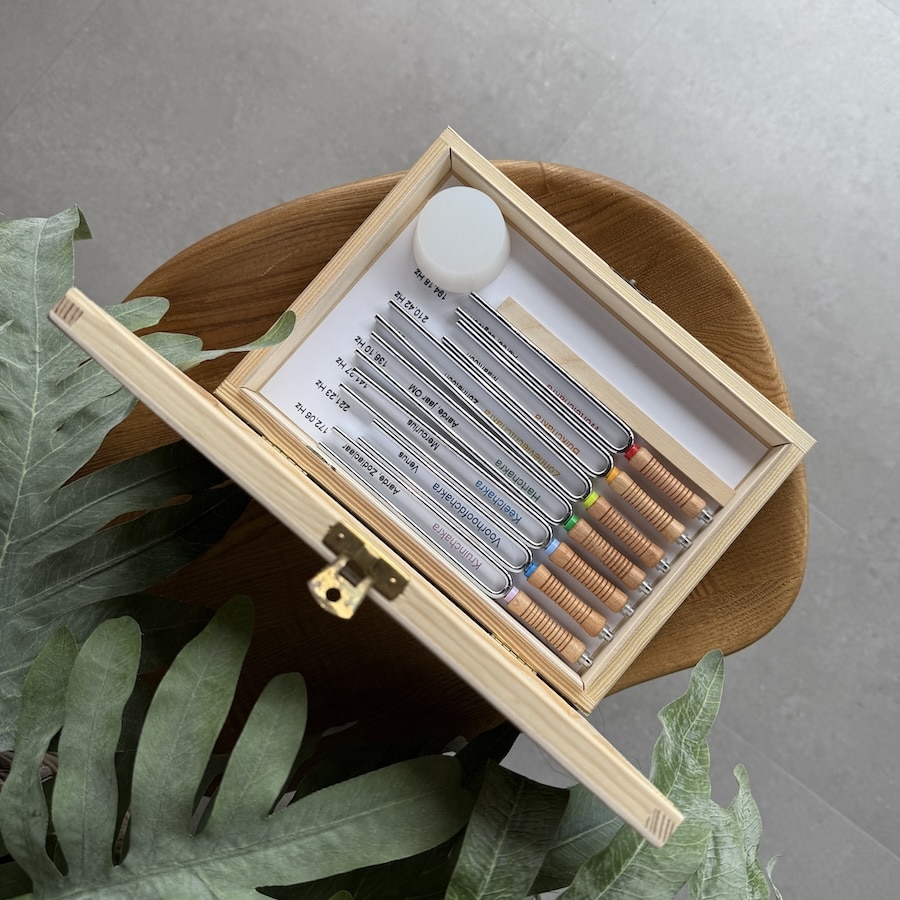
- Root chakra, Earth tone, Day tone, 194.18 Hz,
To vibrate away blockages in the area of the root chakra. For example, lower back pain, pelvic pain and digestive problems. - Sacral chakra, Moon, 210.42 Hz, Zodiac sign: Cancer
Blockages often occur at the sacral chakra. This tuning fork can be used to release them. Place the tuning fork on the pubic bone and on both ends of the hip bone. - Solar Plexus, Sun, 126.22 Hz, Zodiac sign: Leo
To release blockages in the solar plexus. Struggling to assert yourself, feeling vulnerable, suffering from stomach problems and digestive issues, and being greatly affected by your surroundings. - Heart chakra, Earth, annual tone, 136.10 Hz, the OHM sound
A foundational tone that can provide a solution for any ailment. But, of course, it can also be used to vibrate away blockages in the heart chakra.
Deep-seated grief, lung problems, upper back pain. Place the tuning fork on the centre of the sternum. - Throat chakra, Mercury, 141.27 Hz, Zodiac sign: Gemini
To clear blockages in the throat chakra, but also to fill a weak chakra with energy. For issues such as a hoarse voice, chronic coughing, neck tension, and an inability to stand up for yourself and speak your mind. - Third eye chakra, Venus, 221.23 Hz, Zodiac sign: Libra.
To open or close the forehead chakra. Ailments affecting the head, as well as the ears, can be treated with this tuning fork. - Crown chakra, Zodiac year, 172.06 Hz
To open or close the crown chakra. If there is no connection to the higher chakras, this can lead to problems with the head, as well as anxiety and restlessness.
Incorporating tuning forks into your existing treatment
Tuning forks can be easily incorporated into your existing treatment method.
You can use the tuning forks either before or after your treatment.
Sealing the aura after an energy treatment is particularly beneficial. You can use the Heart Chakra tuning fork for this. However, a tuning fork can also be of great value in between sessions if a blockage proves to be persistent.
If you’d like to find out more about using tuning forks, why not consider attending a workshop, where you’ll gain more background information and useful tips on how to use them? Supplied with a tuning block.
All tuning forks are made of sound-retaining stainless steel.