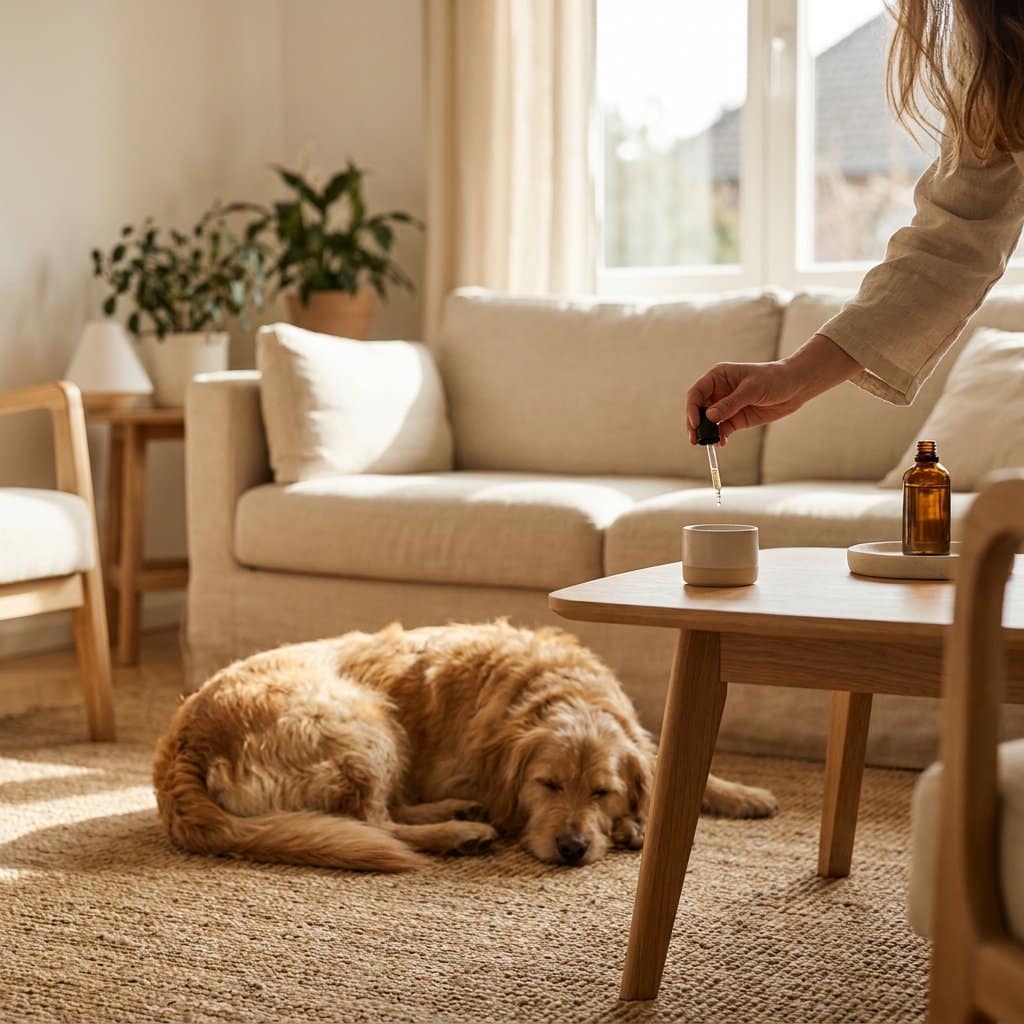

Aromatherapy for dogs requires a different approach to aromatherapy for people. Dogs have a much more sensitive sense of smell and often react more quickly and more clearly to scents. That is why safe, gentle and mindful use is the guiding principle, especially if you want to support a dog in a natural way.
On this page, you can read about what makes aromatherapy dog-friendly, how to get started safely, and what you need to be particularly mindful of. If you’re looking for products specially formulated for animals, you’ll also find the range at De Groene Linde Bella’s Cure – fragrances specially designed for pets.
What is aromatherapy for dogs?
Aromatherapy for dogs involves the careful use of scented products and essential oils in a veterinary context. It is not about using strong scents or large quantities, but about providing subtle support and closely observing the dog’s reaction. What smells mild to us can be very intense for a dog.
In practice, aromatherapy for animals is usually approached with a focus on calm, atmosphere and support. This involves a low-stimulus approach, a safe dilution and sufficient freedom of choice for the animal. A dog must always be able to move away from the scent. You can read more about this in Essential oils and animals: the power of scent.
Safety first: what to look out for
When it comes to aromatherapy for dogs, safety is more important than speed or intensity. Never simply use the same amount, method or frequency as you would for humans. Start small, observe carefully and keep it simple.
- Always opt for a gentle start – Use as little scent as possible and only increase the amount if your dog responds well to it.
- Let your dog choose – a dog must always be able to leave the room or move away from the scent.
- Do not apply essential oil undiluted to the skin – Dilution is the safest approach.
- Take extra care with diffusers – Continuous or heavy vapour inhalation is not suitable for dogs.
- Observe behaviour and body language – Restlessness, running away, sneezing, panting or avoidance are signs that you should stop immediately.
A natural approach is only truly valuable if it also treats the animal with respect. In this case, less is usually better.
Is an aroma diffuser safe for dogs?
A diffuser can be safe for dogs, but only if used sparingly. As dogs have a much keener sense of smell than we do, the scent in a room can quickly become too strong. You should therefore never allow the oil to diffuse for long periods or at high intensity in a closed room.
Would you like to read more about Diffusers around dogs: what is safe?, please follow these basic rules:
- Ensure there is ventilation – Fresh air and an open door are important.
- Brief instructions – Start with a short session rather than vaping for a long time.
- Use a small amount – It is wiser to use a low dose than to create a strong cloud of scent.
- Let your dog move about freely – the animal must be able to choose a different spot for itself.
- Go straight to the comment – if you feel anxious or find yourself avoiding it, stop straight away.
Are you unsure about the correct dosage? See How many drops should I put in the diffuser?.
If you’re unsure whether using a diffuser is suitable for your dog, it’s best to opt for an even gentler method or seek personal advice.
External use: always diluted and used sparingly
When using essential oils on or around a dog, dilution is essential. Essential oils are concentrated and should not be applied undiluted to a dog’s skin, coat or mucous membranes. You should also take into account licking, rolling and direct contact with the coat.
A safe approach starts with a highly diluted solution and a small test dose. It is not the dog’s weight, but its individual sensitivity that often determines how an animal reacts. One dog may be very receptive, whilst another may reject a scent outright.
When using the product externally, please pay particular attention to the following points:
- Avoid using it on its own – Use only when diluted.
- Keep away from the eyes, nose, mouth, genitals and sensitive skin.
- Buy small and local – Never apply more product than is necessary.
- Prevent the dog from licking it straight away.
- Stop if you feel irritated or restless – redness, scratching or avoidance are clear signs.
Which scent is soothing for dogs?
There is no single scent that is calming for every dog. Dogs vary greatly in terms of sensitivity, preference and situation. What feels pleasant to one dog may actually be too much for another.
Lavender It is often described as a gentle scent, and on the De Groene Linde website, lavender oil is also mentioned in the context of massages for dogs. However, the same advice applies here: use it sparingly, ensure it is well diluted, and always monitor your dog’s reaction.
In dogs, a sense of calm is not only induced by the scent itself, but also by the way it is applied. A calm environment, minimal stimuli and a subtle dosage often make the biggest difference.
When aromatherapy is and isn’t appropriate
Aromatherapy may be a good option if you want to use scent in a gentle, mindful way in your dog’s living environment. It is particularly suitable for owners who want to take things slowly and carefully observe their pet’s behaviour.
Extra care is needed if your dog already reacts strongly to stimuli, becomes agitated easily or seems sensitive to new smells. Do not use aromatherapy as a quick fix and never force your dog to come into contact with a scented product.
If in doubt, a simple rule helps: if you’re not sure whether your dog is comfortable with it, do less or stop. That cautious approach is best suited to Safe use of essential oils for dogs.
Products specifically for animals
If you’re looking for products that are clearly designed for animals, De Groene Linde offers the Bella’s Cure for Animals range. Within this range, you’ll find products specifically intended for animals, including dogs, such as Over Excited, Fear Free, Confidence and Doggy Outdoor.
As not every dog reacts in the same way, personalised advice can help you choose a suitable option. When it comes to aromatherapy for dogs in particular, making an informed choice is more important than simply trying out lots of different options.
Frequently Asked Questions
Can dogs tolerate the smell of lavender?
It varies from dog to dog. Lavender is often considered a mild scent, but even then, you should start very gently and keep a close eye on your dog. Always make sure your dog can leave the room if it wants to, and never use a scent that is too strong.
Is aromatherapy also suitable for a home with cats?
In that case, extra caution is required. Cats react differently to essential oils than dogs do, so use pet products very carefully and do not automatically apply a dog-centred approach in a household with cats. Here too, it is important that the cat is able to leave the area where a scent is being diffused. NEVER use essential oils on a cat’s coat or internally. Cats are unable to break down the naturally occurring chemicals contained in essential oils.
How can you tell if a dog doesn’t like a particular smell?
Common signs include running away, becoming restless, heavy panting, sneezing, turning one’s head away or trying to leave the room. If you notice this behaviour, stop immediately and ventilate the room.
Can you just use any essential oil on dogs?
No. Not every essential oil or aromatherapy product is suitable for dogs. You should therefore opt for products that are clearly intended for use on animals and always use them with caution. Want to know more? Read About Bella’s Cure: why a pet range?.
Related articles

Samenwerking in Ontspanning en Welzijn voor de Zorg!
Stichting Massage voor de Zorg is een prachtig initiatief waar wij graag mee in verbinding zijn. Door het fijne contact met operationeel directeur Eric Both hebben wij al veel mogen...
Read more

Koshi, discover the magic of sound and nature
A gentle breeze, the sound of rippling water or the rustling of leaves. Sound can have a special effect on you. It can take you out of your head and draw your attention...
Read more

Working with Koshi’s, the magic of sound and the four elements
Perhaps you’ve experienced that moment when someone plays a Koshi. During a yoga class or some other relaxing moment. The first notes sound clear and soft, and then seem to….
Read more