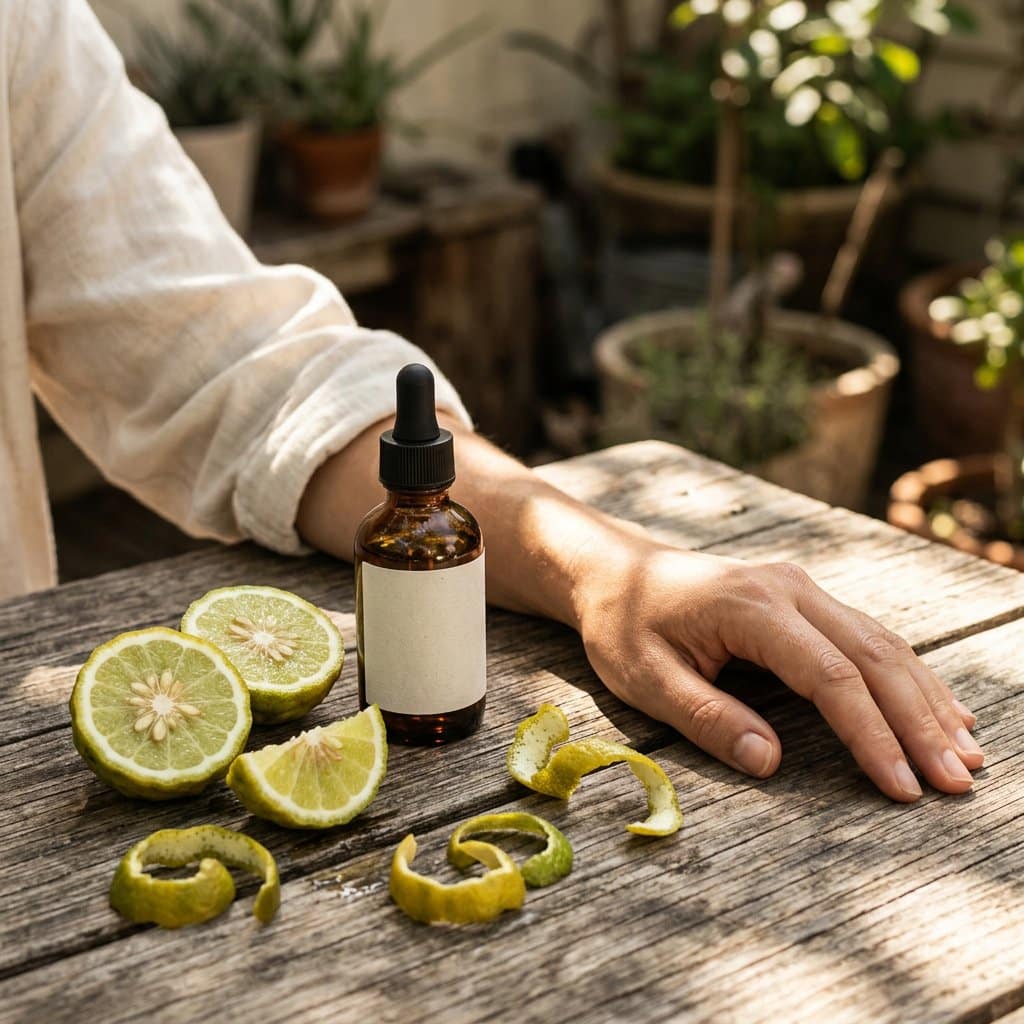

Phototoxicity associated with essential oils
Some essential oils can make your skin more sensitive to UV light after use. We call this phototoxicity. It mainly applies to oils or blends that you apply to the skin, such as a roll-on, massage oil, balm or perfume blend, and is therefore not a general warning for all uses of essential oils.
Certain citrus oils, in particular, require extra care in this regard. On this page, you can find out which oils are most commonly mentioned, how to use them safely on your skin, and how to distinguish between phototoxicity and ordinary irritation or an allergic reaction. This will enable you to make informed choices and ensure that using natural products really is safe.
Why the sun and certain oils aren’t a good combination
Phototoxicity is a reaction between UV light and certain substances that remain on your skin after application. In the case of essential oils, this mainly concerns compounds found in some citrus oils. If the skin is subsequently exposed to sunlight or other UV radiation, it may react more strongly than you might expect.
That’s more than just “burning more quickly”. A phototoxic reaction can manifest as redness, a burning sensation, blotchiness, discolouration or any other unpleasant skin reaction in the area where you’ve applied the oil. Sometimes you don’t notice this straight away, but only later that day or the following day after sun exposure.
It is important to note that this risk mainly applies to topical use. If you use essential oil in a diffuser, different safety rules apply. Phototoxicity does not occur because essential oil is “dangerous” in itself, but because a specific oil or blend comes into contact with the skin and is then exposed to UV light.
Precisely because essential oils are natural, they are sometimes automatically regarded as mild. Yet essential oils are highly concentrated plant extracts. So ‘natural’ does not automatically mean safe in every situation, certainly not when used undiluted or just before sun exposure. That is why the label, product information and a little caution in the sun are not mere formalities, but an important part of the Safety when using essential oils.
Which essential oils require extra care in the sun?
In practice, this mainly concerns citrus oils. Take particular care if you are using a pure oil, skin blend or roll-on containing any of the oils listed below. The exact warning depends on the specific product and how the oil has been made, so always refer to the label.
|
Single oils |
When should you be particularly careful? |
A practical rule of thumb |
|---|---|---|
|
Bergamot |
It is best known for the risk of phototoxicity when applied to the skin, particularly if it is not a specially formulated variant. |
Do not use on exposed skin immediately before sunbathing or using a sunbed. Always follow the product warnings. |
|
Lemon |
Take particular care with oil extracted from the peel and with products that come into contact with the arms, neck or face. |
If you’re not sure, it’s best to use it in the evening or on skin that will remain covered. |
|
Lime |
Just like lemon, it is a citrus oil where topical application and UV exposure are not a sensible combination. |
Keep a safe distance from direct sunlight and follow the instructions on the label carefully. |
|
Grapefruit |
This may require extra care when used in skincare products, particularly if the blend contains a high proportion of citrus. |
Do not apply to skin that will be exposed to significant amounts of sun on the same day. |
|
Mandarin |
It is often perceived as milder, but here too, the product variant remains important. |
Don’t automatically assume it’s safe: check the label and take care in sunny spots. |
|
Orange |
With oranges, too, the use of the peel is slightly different from using them to spread a fragrance around the house. |
Read the warning on the product and avoid the sun if instructed to do so. |
This applies not only to individual bottles of essential oil, but also to blends, roll-ons and other skincare products containing these citrus oils. If you spot citrus in the list of ingredients, that’s your cue to take extra care in the sun. If you want to work specifically with bergamot, please read this first Bergamot oil: uses and points to bear in mind.
How to use essential oils safely on your skin
Safe sun exposure doesn’t start with “as little as possible”, but with “as mindfully as possible”. By following these guidelines, you can significantly reduce the risk of phototoxicity and other skin reactions.
- For How to dilute essential oil safely Always use a base oil or carrier oil first before applying it to the skin. Essential oils do not mix well with water, so adding a few drops to water does not automatically make it safe or ensure it is evenly distributed when applied to the skin. For roll-ons, use the Dilution chart for roll-ons to ensure that doses remain within safe limits.
- If you’d like to find out more about Choosing a carrier oil When using essential oils, jojoba, sweet almond or grape seed oil are pleasant, neutral options for the skin. This allows you to apply the essential oil more evenly and keeps the concentration on the skin more manageable.
- Take extra care in areas that are exposed to a lot of sun, such as your wrists, neck, shoulders, décolleté and face. It is precisely in these areas that a citrus-rich oil or blend is more likely to cause problems if you go outside afterwards.
- Always leave a gap between applying the product to your skin and exposure to the sun. If you cannot avoid being out in the sun that day, it is best to apply it in the evening or only to skin that will remain covered.
- Read the label and product information from start to finish. This applies to pure essential oils, but just as much to ready-to-use roll-ons, massage blends, balms and other natural skincare products.
- Check the list of ingredients if you’re using a blend. If you see bergamot, lemon, lime, grapefruit, mandarin or orange listed, that’s a reason to be particularly careful, even if the product has already been diluted.
- Don’t assume that “100% natural” means the same as “risk-free”. Essential oils are concentrated, which is precisely why dosage and method of application are so important.
- Do not use a diffuser in the same way as you would apply oil to the skin. When the oil is vaporised, it is released into the air, whereas phototoxicity is a concern only when certain components are applied to the skin and are subsequently exposed to UV light.
- Stop using the product immediately if your skin reacts strongly or if you experience redness, a burning sensation, irritation or tightness. Do not continue to apply the product to see if the symptoms “go away”. If symptoms persist or are severe, it is advisable to seek expert advice.
- Do not take essential oils orally unless a product is explicitly intended for this purpose, as stated by the manufacturer. For standard aromatherapy oils and skin blends, oral ingestion is not a safe standard practice.
- If you’re unsure about a particular type of citrus oil – for example, whether it has been produced in a way that might alter the risk associated with sun exposure – err on the side of caution. When it comes to topical use, there’s no certainty: it’s better to keep a greater distance from the sun than too little.
- The same basic rule applies to De Groene Linde’s ready-to-use products: don’t just look at the scent or effect you’re after, but also at how to use the product, the ingredients and any warnings regarding skin and sun exposure.
Phototoxic, irritating or allergenic: here’s the difference
Not every skin reaction to essential oils is the same. In practice, phototoxicity, irritation and allergy are often lumped together, even though they are three different things. It is important to make this distinction, as it also determines what you need to do differently in future.
A phototoxic reaction is caused by the combination of applying the oil to the skin and exposure to UV light. The oil itself is not the whole story: the problem only arises when certain substances are present on the skin and are subsequently exposed to sunlight. That is why phototoxicity is particularly common with certain citrus oils and citrus-rich blends. The reaction usually occurs exactly where you applied the product and later exposed it to light.
Such a reaction can resemble a severe sunburn: redness, warmth, a burning sensation, dark or patchy discolouration, which sometimes only becomes visible hours later. That makes it confusing. People sometimes think they’ve “just been in the sun for too long”, whilst in fact the combination with oil on the skin has actually exacerbated the reaction.
Ordinary skin irritation works differently. You don’t need UV light for that. In such cases, the skin is simply reacting to too high a concentration, a sensitive skin barrier, or an oil that is too intense for your skin at that moment. You often notice irritation more quickly: a stinging or burning sensation, redness or a tightening sensation shortly after application. This can happen with citrus oils, but also with completely different essential oils.
An allergic reaction is a different matter altogether. Your immune system plays a role in this. You don’t necessarily experience symptoms the first time you use it; sometimes sensitivity only develops after repeated exposure. After that, even a small amount can cause an itchy, eczema-like or persistent skin reaction. This is therefore different from a phototoxic reaction, which actually requires UV light to occur.
Why do these reactions actually occur?
Because essential oil is not simply a mild “plant extract”, but a highly concentrated mixture of many different natural substances. A single bottle contains dozens, and sometimes even hundreds, of aromatic and plant-based components. It is precisely this richness that makes essential oil so special, but it is also something that must be handled with care.
In citrus oils, for example, you often come across limonene. On an ingredients list, this is usually listed as “Limonene”. This is not some strange ‘artificial’ additive, but a natural fragrance component that occurs naturally in many citrus fruits. Nevertheless, it is important that you see this name on packaging, as such ingredients can cause sensitivity in some people and are therefore listed on labels.
That is why you see warnings, allergen listings and sometimes hazard symbols on the packaging of essential oils and cosmetic products. These are not there to make using natural products seem daunting, but to make it clear that concentrated plant extracts must be used with care. This is particularly important with pure oils.
Limonene is also a practical example of why old oil can react differently from fresh oil. When an oil is exposed to air, light or heat for long periods, certain components can oxidise. Oxidised oil can irritate the skin more quickly or make it more sensitive. This isn’t limited to citrus oils, although it’s often seen there because the fresh top notes change more quickly.
That is an important distinction right from the start: an old or oxidised oil may be particularly irritating, but that is not the same as phototoxicity. Phototoxicity is linked to UV light and specific components on the skin. Oxidation relates to the ageing of the oil itself. An oil can therefore be irritating without being phototoxic, and conversely, a fresh oil can still have phototoxic properties if used incorrectly in sunlight.
So, if you’ve ever had a reaction after using a citrus blend, that doesn’t automatically mean you have “an allergy to essential oil”. Perhaps it was due to sun exposure. Perhaps the oil was diluted too much, or not diluted enough. Perhaps your skin barrier was already sensitive. And perhaps the oil had oxidised. That is precisely why it’s wise not to jump to conclusions about a single cause, but to take a close look at the timing, the area affected and the method of use.
A few practical differences can help you tell the difference. Does your skin only react after you’ve been in the sun, and only in the exact spot where the product was applied? If so, this is more likely to be phototoxicity. Does it feel immediately burning or stinging without any sun exposure? Then this is more likely to indicate irritation. Does itching or a persistent eczema-like reaction develop later on, possibly even after repeated use? Then an allergic reaction may be a factor.
As essential oils are so concentrated, it is wise to build up your use gradually. Even with 100% natural products, the origin of the plant does not tell the whole story about how your skin will react. Dosage, product form, skin type, the product’s age and exposure to sunlight all make a difference.
That is why proper storage is more than just a minor detail. Always seal bottles tightly, do not store them in warm places or in bright light, and watch out for any changes in smell. If an oil smells different from usual – flatter, sharper or “stale” – that’s a sign to be extra vigilant. Especially when applying it to the skin, you don’t want to use a product whose quality or freshness is questionable.
The form of the product also matters. A pure essential oil, a roll-on, a balm and a massage blend are used differently, but the basic rule remains the same: anything that comes into contact with the skin requires careful consideration regarding dilution, ingredients and sun exposure. A diffuser has different safety rules; phototoxicity does not play a role in the same way as it does with skin contact.
If you see warnings on a label about external use, allergens or the sun, take them very seriously. They’re there for a reason. And if you’re not sure whether you’re experiencing phototoxicity, irritation or an allergic reaction, stop using the product and seek expert advice. That’s not an overreaction, but simply a sensible way to handle potent natural ingredients.
If you want to be extra careful
Sometimes, “using with care” isn’t enough, and exercising extra caution is simply the wisest choice. This is particularly true in situations where the skin reacts more quickly, where you use the product more frequently, or where a vulnerable group is involved, because Contraindications for the use of essential oils …will come into play sooner.
- If you have sensitive skin, it is usually wiser to use essential oils less frequently and in smaller quantities than to experiment straight away on larger areas of skin. Skin that reddens easily, feels dry or reacts quickly to cosmetics may also react more strongly to essential oils, even if a product is natural and well diluted.
- If your skin barrier is temporarily out of balance – for example, after excessive sun exposure, exfoliation, shaving, or if your skin already feels irritated – it’s best to hold off using skincare products for a while. At times like this, an oil may sting or burn more easily. When using citrus products on skin that’s already under strain, it’s also particularly important to remain cautious in the sun.
- If you regularly apply essential oil to your skin – for example, daily on your wrists, neck or shoulders – be aware of cumulative effects. Even if you’ve never experienced any problems before, frequent use on the same areas can make your skin more sensitive. Frequent users in particular would be well advised to vary their application, use low doses and incorporate sun exposure into their routine.
- If you’re someone who likes to combine several products, such as a body oil, a roll-on and then a natural perfume, take a close look at any overlap in ingredients. A single product containing citrus might seem harmless, but applying several layers to the same area of skin can still mean you’re exposed to more than you realised. Being extra careful in this case means: layering less and choosing more carefully.
- With babies, it is particularly important to exercise caution. Their skin is more delicate and reacts differently to adult skin. You should therefore only use products specifically designed for babies, follow the age and usage instructions carefully, and, if in doubt, avoid applying anything to the skin. Even with a gentle blend, the following still applies: if it contains citrus, you must still take care when exposing the skin to the sun.
- The same basic principles apply to children, even though they are bigger and more active than babies. Don’t simply use an adult blend on a child’s skin just because it’s “natural”. Check the product information, take note of the recommended age, and be particularly careful if a child is going to play outside in the sun afterwards. A citrus roll-on applied to the wrists or neck simply requires a bit more care in such cases.
- For products or blends specially formulated for babies or children, the label remains the guiding principle. A children’s range or a mild fragrance does not automatically mean that sun exposure is no longer a factor. If a product is intended for use on the skin and contains citrus ingredients, taking care in the sun is still part of responsible use.
- During pregnancy, many people make a conscious choice to use natural remedies, but it is precisely at this time that it is wise to exercise caution. Not every essential oil is suitable for every situation or stage. In this context, taking extra care mainly means: opting for a lower dosage, avoiding application to the skin and choosing to diffuse the oil rather than applying it topically.
- Even if you normally tolerate essential oils well, it’s a good idea to adjust your routine during sunny spells or whilst on holiday. Products that you used on your neck without a second thought in winter may suddenly seem less appropriate in summer. Using them sparingly on the skin, applying them only to covered areas, or waiting until the evening to use them is often the most practical solution.
- If you’re unsure whether an oil is suitable for your situation, keep it simple. Use less, dilute it more and, if possible, opt for a method that avoids direct skin contact, such as diffusing it in accordance with the instructions for use. This isn’t a compromise, but rather a safe way to enjoy the scent and atmosphere without the unnecessary risk of a skin reaction.
- If you notice that your skin keeps reacting, if symptoms keep recurring, or if you’re not sure whether it’s phototoxicity, irritation or an allergy, stop using the product. Carrying on using it usually doesn’t make things any clearer. If symptoms persist or you’re unsure, seeking expert advice is the wisest next step.
- Ultimately, being extra careful doesn’t mean you have to avoid essential oils, but that you should be more mindful about choosing the right way to use them. Sometimes applying them to the skin in a diluted form with carrier oils is fine, sometimes diffusing them makes more sense, and sometimes it’s simply best to give them a miss. If you take your skin type, the season and the ingredients into account, you’ll use them much more safely and with greater peace of mind.
Related articles

Orthoceras, the ancient wisdom of the Earth
Some stones carry a story that is far older than humankind. A story that can be clearly felt in the stone’s energy. The Orthoceras fossil is...
Read more

Working Together for Relaxation and Wellbeing in the Care Sector!
The Massage for Care Foundation is a wonderful initiative that we are delighted to be associated with. Thanks to our excellent relationship with the operational director, Eric Both, we have already been able to…
Read more

Koshi, discover the magic of sound and nature
A gentle breeze, the sound of rippling water or the rustling of leaves. Sound can have a special effect on you. It can take you out of your head and draw your attention...
Read more