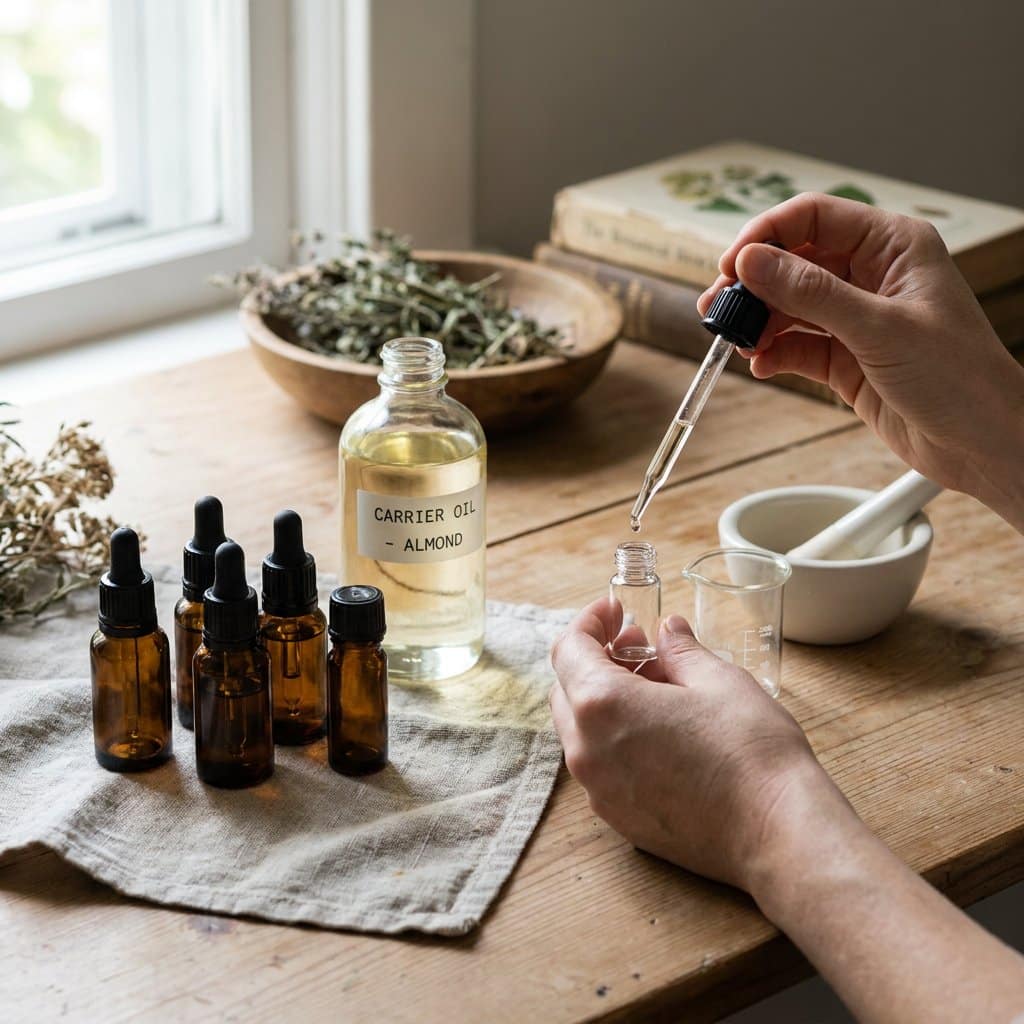

Before applying essential oil to the skin, you should always dilute it with one of our base oils (carrier oils), not with water. A practical guideline is often 1% for the face or sensitive skin and 2% for an adult’s body. Converted, this means that 10 ml of carrier oil contains approximately 2 drops at 1% and 4 drops at 2%. Below, you can read about what to use for dilution, how to work out the quantities and what to bear in mind for safe use.
Why applying it directly to the skin is usually not a good idea
Essential oils are highly concentrated plant extracts. As a result, you only need a small amount, but this is precisely why, when undiluted, they are often too intense for direct skin contact. Using them undiluted can cause redness, a burning sensation, itching or hypersensitivity, especially if you have sensitive skin or use the same oil frequently.
Diluting the oil helps it to feel gentler on the skin and makes it easier to spread. A good carrier oil slows down the absorption, makes application easier and means you need fewer drops. This is not only gentler on your skin, but also more economical. Ideally, choose a pure, 100% natural essential oil and a high-quality carrier oil, so that you know exactly what you’re applying to your skin.
What can you use to dilute essential oil?
For use on the skin, dilute essential oil with a carrier oil. This is a vegetable-based oil that is barely volatile, if at all, and feels pleasant on the skin. Which carrier oil suits you best depends on your skin type, where you’re applying the oil and your personal preference for texture. Read more about the difference between refined, cold-pressed and macerated.
- Jojoba oil – light, stable and gentle on the face and sensitive skin.
- Fractionated coconut oil – light, virtually odourless and absorbs quickly.
- Sweet almond oil – a gentle all-rounder for the body and massage; less suitable for those with a nut allergy.
- Grape seed oil – a light oil that’s ideal if you don’t want a greasy film.
You can also mix essential oil into a neutral cream, lotion or other suitable cosmetic base. This is handy if you’d rather not use undiluted oil.
Do you mainly want to apply cream or give a massage? Take a look at the guidelines for massage with essential oils.
Why diluting essential oil with water doesn’t work
Essential oil does not dissolve in water. If you add a few drops to water, they remain as separate droplets of oil. These can still end up on the skin in concentrated form. That is why diluting essential oil with water is not a safe method for use on the skin, in the bath or for a simple DIY spray. Always use a suitable carrier oil that can actually carry or disperse the oil. Read how to Using essential oils in the bath handles it safely.
What ratio do you use?
The correct dilution depends on where you use the oil and how sensitive your skin is. For everyday cosmetic use, the general rule is: start low and only increase the concentration if absolutely necessary. For the face and sensitive skin, 0.5% to 1% is often a sensible starting point. For the body of adults, 1% to 2% is often used.
A handy rule of thumb is: 1 ml of essential oil is approximately 20 drops. The exact number may vary from bottle to bottle, so please regard this as a practical guide rather than a laboratory measurement.
|
Dilution |
When used frequently |
In 10 ml |
In 30 ml |
In 50 ml |
|---|---|---|---|---|
|
0,5% |
Face, very sensitive skin, start gently |
1 drop |
3 drops |
5 drops |
|
1% |
Sensitive skin or mild daily use |
2 drops |
6 drops |
10 drops |
|
2% |
The adult body |
4 drops |
12 drops |
20 drops |
It’s best to make a small amount first, for example 10 ml or 30 ml. That way, you can take your time to see how your skin reacts and avoid wasting any.
For children (see safe use in babies and children), during pregnancy, if you have very sensitive skin or existing skin conditions, it is advisable to take extra care. In such cases, it is best to choose a low dilution and always follow the product instructions. If in doubt, seeking personal advice is the safest option.
How to make a blend safely
Would you prefer a handy roll-on for when you’re out and about? Find out how to Make your own roller.
- Choose a clean, dark-coloured glass bottle if you want to store the mixture.
- First, measure out your carrier oil or cosmetic base.
- Then add the correct number of drops of essential oil.
- Gently shake or roll the bottle so that everything mixes thoroughly.
- Write the name, date and dilution on the label.
- Always carry out a skin test on a small area first – for example, in the crook of your elbow – and wait 24 hours.
If you use citrus oils on your skin, always check whether they are photosensitive. Some citrus oils make the skin more sensitive to the sun or UV rays. Always follow the instructions on the label or in the product information.
What should you do if you have a skin reaction?
If your skin does react to a blend or to a pure oil, stop using it immediately. Then apply some extra carrier oil to the area to further dilute the essential oil. It is best not to use water, as oil and water do not mix and the irritation will not be properly alleviated.
If your skin remains irritated, gently wash the area later using a mild cleanser. If the symptoms become severe, spread to other areas or if you’re unsure, contact a doctor. A simple skin test beforehand can save you a lot of trouble, especially with new oils or if you tend to have a sensitive reaction.
Frequently Asked Questions
Can I mix essential oil with water?
No. Essential oil does not dissolve in water. The droplets remain separate and may come into contact with the skin or mucous membranes in a concentrated form. For topical application, use a carrier oil or a suitable cosmetic base.
How many drops of essential oil are there in 10 ml?
That depends on the dilution. In 10 ml, you use approximately 1 drop for 0.5%, 2 drops for 1% and 4 drops for 2%. This is based on the practical assumption that 1 ml is approximately 20 drops.
How can you dilute rosemary oil?
Rosemary oil should be diluted in the same way as other essential oils: in a carrier oil or cosmetic base. It is best to start with a low concentration – for example, around 1% for sensitive skin and 2% for general skin use – and avoid contact with the eyes and mucous membranes.
Which carrier oil is best?
There isn’t one single best choice for everyone. Jojoba oil is lovely for the face and sensitive skin, fractionated coconut oil is light and has a subtle scent, and sweet almond oil is a gentle all-rounder. Above all, choose a pure oil that feels pleasant on your skin.
Is it safe to use essential oils during pregnancy?
Exercise extra caution when using essential oils during pregnancy, particularly on the skin. Only use products and oils that are suitable for this purpose, opt for a low dilution and, if in doubt, seek advice from an expert who is familiar with your situation.
Related articles

Koshi, discover the magic of sound and nature
A gentle breeze, the sound of rippling water or the rustling of leaves. Sound can have a special effect on you. It can take you out of your head and draw your attention...
Read more

Working with Koshi’s, the magic of sound and the four elements
Perhaps you’ve experienced that moment when someone plays a Koshi. During a yoga class or some other relaxing moment. The first notes sound clear and soft, and then seem to….
Read more
Happy Autumn: turning inwards, letting go and enjoying the moment
Autumn is here. Whilst for some it means cosiness, for others autumn can evoke a completely different feeling. And with that different feeling, I am...
Read more