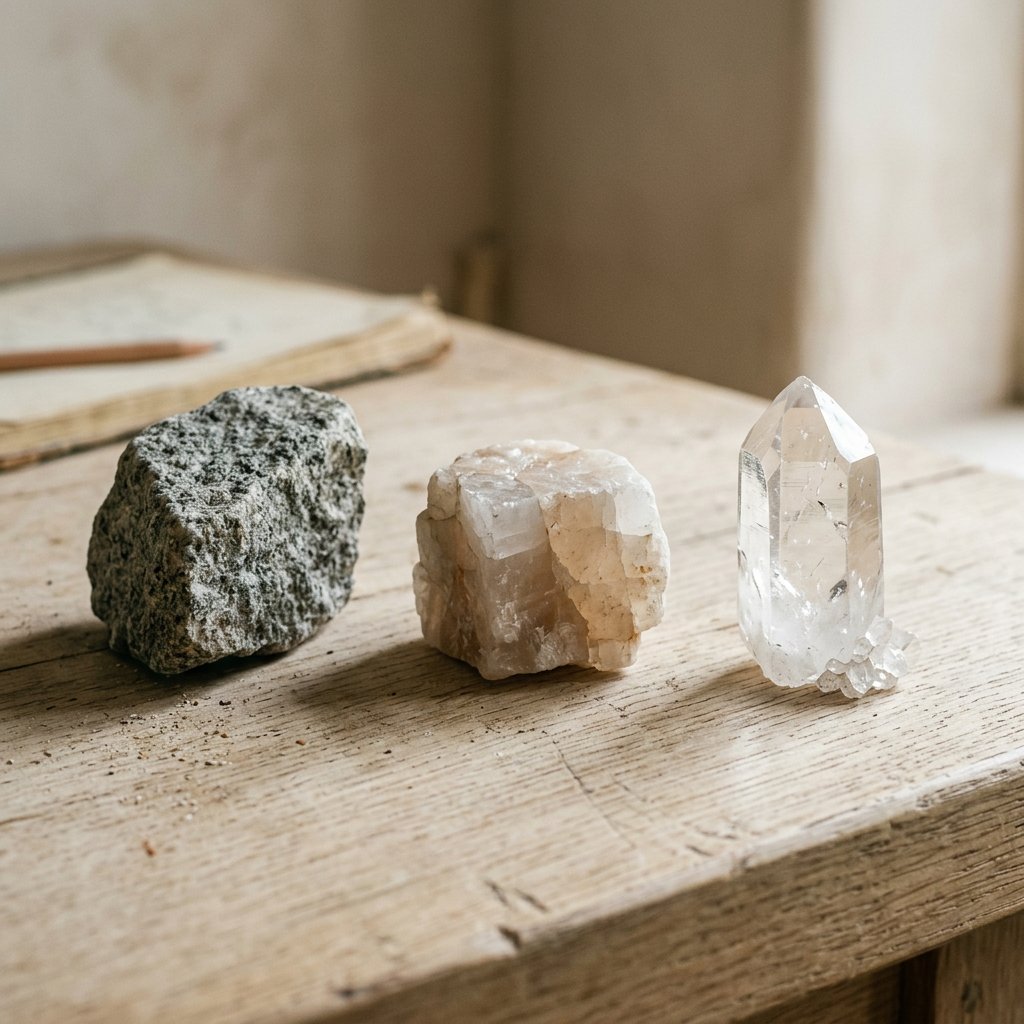

The difference between a mineral, a rock and a crystal
The short answer is: a mineral is a natural building block; a crystal is the ordered form in which such a mineral can grow visibly; and a rock consists of one or more minerals combined. However, in everyday language and in online shops, these terms are often used interchangeably. This leads to confusion between the material, its form and its trade name.
Once you’re aware of that difference, you’ll find it much easier to read product names. This helps with names such as rock crystal, calcite, geodes, rough pieces, angel aura, opalite and citrine. Also, when you’re browsing through a range of crystals such as the one at De Groene Linde, you’ll be able to see more quickly whether a name tells you anything about what it is, how it formed or how it’s sold. Curious to find out what you can do with them next? Then read on The use of crystals.
From building block to brick: how to understand these terms
The quickest way to see the difference is to compare the terms side by side:
|
Term |
What’s it about? |
Explanation in plain language |
Example |
|---|---|---|---|
|
Mineral |
Composition and structure |
A natural building material with its own distinct internal structure. |
Calcite and quartz are minerals. |
|
Crystal |
Structure and growth |
The ordered growth of a mineral, often visible as points, faces or distinct shapes. |
Rock crystal is clear quartz that is often sold in its natural crystal form. |
|
Rock |
Collection of minerals |
The general geological term for natural solid material. ‘Gesteenten’ is simply the plural of ‘gesteente’. |
A geode is a rock with crystal growth on the inside. |
|
Gemstone |
Use and trade |
Primarily a term used in jewellery and trade to refer to beautiful or prized stones; less precise than the geological terms. |
A crystal can be sold as a gemstone, but the two terms do not mean the same thing. |
Why a single brick can have several labels
One and the same thing can be referred to in different ways at the same time. That isn’t necessarily wrong, but you do need to know what sort of information a name conveys.
- The terms ‘geode’, ‘cluster’, ‘rough stone’ and ‘tumbled stone’ mainly refer to shape, growth or finish. A geode refers to a stone with a cavity and crystals inside. A cluster is a group of crystal points gathered together. A rough stone is unworked, whilst a tumbled stone is smoothly polished. These terms do not, therefore, automatically indicate which mineral a piece is made of.
- Names such as rock crystal and calcite can be found, for example, in Crystals A–Z, and they *are* names of minerals. Rock crystal is a clear form of quartz, and calcite is a mineral that can grow in all sorts of shapes. So a piece like this can be a mineral, a crystal and a rough stone all at once, depending on what you’re looking at.
- Some names are trade names or refer primarily to the appearance. ‘Angel aura’ is a good example of this. It is not a distinct type of mineral, but a name for a treated base stone. The name therefore says more about the visual effect than about a new, natural material.
- Opalite also often causes confusion. Opalite is usually a man-made material, but many people still regard it as a crystal because it looks shiny and stony. The name sounds natural, although geologically speaking it is not the name of a mineral.
- With citrine, things get even more mixed up. In the trade, natural and heat-treated varieties are regularly sold under the same name. The name ‘citrine’ therefore does not always provide enough information about exactly how the stone was formed or treated.
- Good product information makes it much clearer what you’re buying. Ideally, it should state whether something is natural, treated, synthetic or imitation. That way, you’ll have a better idea of whether a name refers to the material, the finish or, above all, how a stone is actually marketed.
This is how crystals are formed and how they take on their shape
Crystals form when particles arrange themselves in a regular pattern under the right conditions. This can happen when magma cools slowly, when minerals in the Earth’s crust are transformed by pressure and temperature, or when mineral-rich water causes substances to precipitate. If this growth proceeds slowly enough, the material builds up step by step into an ordered crystal structure.
It is important to distinguish between the inside and the outside. The true order of a crystal lies within: that is where the mineral’s fixed pattern is found. The points, faces and lines that you see on the outside are the visible result of that growth. A crystal therefore does not need to be perfectly smooth to still have a genuine crystal structure. Inclusions, minor imperfections and irregular growth are, in fact, often part and parcel of natural formation.
One of the reasons crystals look so different is down to their varying crystal systems. As a result, one mineral may grow in a block-like shape, whilst another may grow in a needle-like, plate-like or pointed form. There are also lab-grown crystals, which are produced by mimicking the natural growth process. Such a synthetic crystal is different from an imitation made of glass or plastic: not only does it resemble a crystal, but it is also structurally distinct from purely decorative imitation materials.
You can read more about growth and structure in How are crystals formed?
What should you look out for when trying to identify a crystal?
It’s usually not possible to identify a crystal using just one quick trick. It’s wiser to look at several indicators at once: its appearance, the description, the price and the seller’s transparency. You can find more practical tips in Identifying gemstones.
- First, look at the product name and the product specifications. Does it just have a catchy sales name, or does it also clearly state what the material is? A good description distinguishes between the mineral name, the variety name and any treatment. This prevents confusion with names such as angel aura, opalite or citrine.
- Please note that natural colour variations may occur. Genuine stones often exhibit slight differences in shade, transparency and pattern. This is certainly true of rough pieces, but also applies to polished ones. If several specimens have exactly the same colour, lustre and appearance, it is wise to examine them more closely.
- Look for inclusions, cloud-like patterns, growth lines and minor irregularities. In natural stones, you often see subtle traces of growth or formation. These need not be conspicuous – certainly not in polished pieces – but a stone that looks too perfectly smooth and flawless may raise questions.
- Minor imperfections are normal. A natural stone does not need to be symmetrical, perfectly smooth or completely uniform. In fact, it is precisely the tiny pits, edges, internal lines or varying sheen that can be characteristic of genuine material. This does not mean that every rough detail is proof of authenticity, but it does mean that perfection is not always the most natural indicator.
- Be careful with home tests. The fact that a stone feels cool to the touch, seems heavy or reacts in a certain way when placed in water proves very little on its own. Glass can also feel cool to the touch, and different materials can look very similar. Furthermore, scratch tests or other rigorous tests can cause damage.
- Take the price into account, but don’t jump to conclusions. A low price doesn’t automatically mean something is fake, and a high price doesn’t automatically mean something is genuine. That said, if a piece is exceptionally large, clear, appears rare or is brightly coloured, yet is on sale at a strikingly low price, it’s worth asking a few extra questions.
- Ask about the origin and treatment if that’s important to you. Particularly with popular stones, it’s useful to know whether something is natural, treated, synthetic or imitation. A transparent seller will clearly state this information, precisely because a single name doesn’t always tell you exactly what you’re looking at.
- When dealing with valuable or questionable items, it is wise to seek extra assurance. In such cases, check that the product specifications are truly complete and, if necessary, consult a gemmologist for an expert assessment. For a decorative or personal item, clear product information is often very valuable in itself, but with more expensive purchases, you are perfectly entitled to expect more substantiation.
Have you found your stone and want to look after it properly? Then read how to do so in Cleansing and recharging crystals and stones.
Related articles
Orthoceras, the ancient wisdom of the Earth
Some stones carry a story that is far older than humankind. A story that can be clearly felt in the stone’s energy. The Orthoceras fossil is...
Read more

Working Together for Relaxation and Wellbeing in the Care Sector!
The Massage for Care Foundation is a wonderful initiative that we are delighted to be associated with. Thanks to our excellent relationship with the operational director, Eric Both, we have already been able to…
Read more

Koshi, discover the magic of sound and nature
A gentle breeze, the sound of rippling water or the rustling of leaves. Sound can have a special effect on you. It can take you out of your head and draw your attention...
Read more