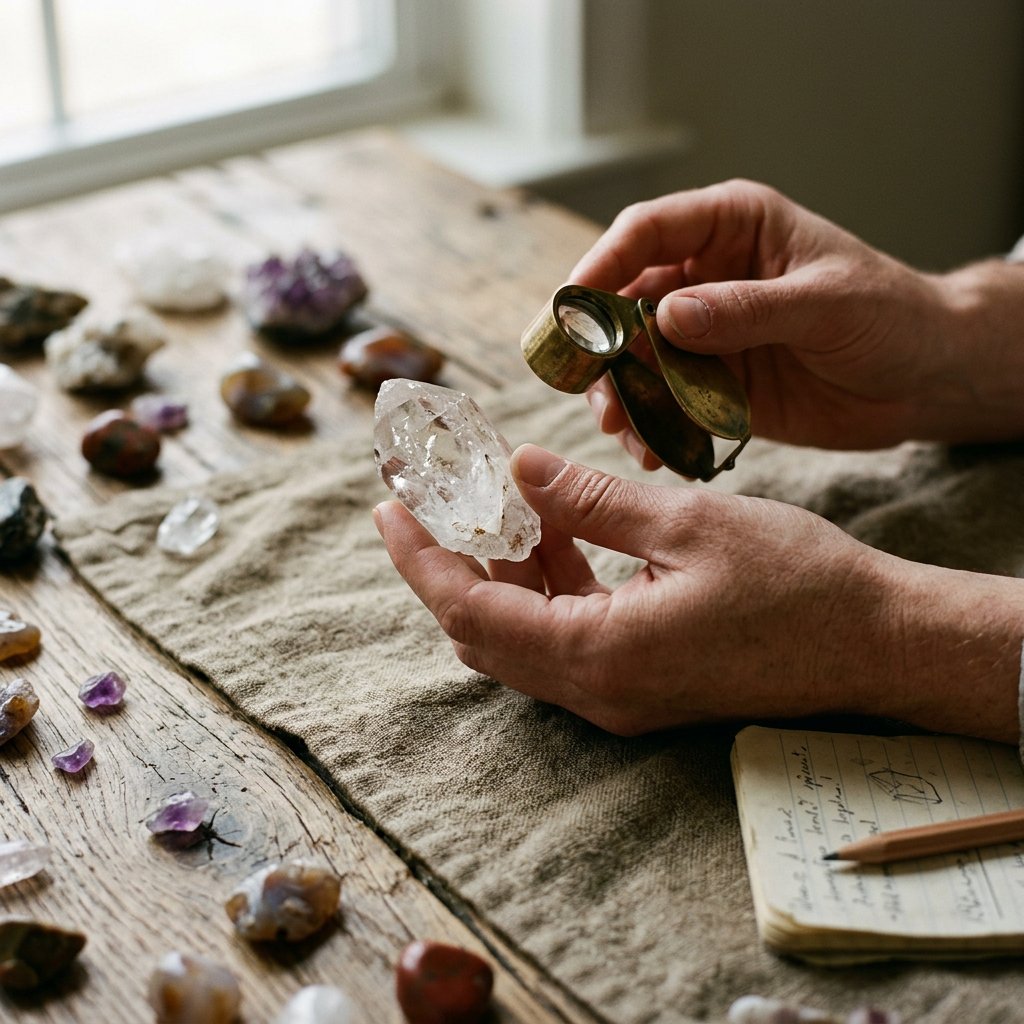

At home, you can almost never reliably identify a gemstone based solely on its colour, a label or a photograph. If you really want to take a closer look, you should always consider several characteristics together: appearance, lustre, hardness, weight, structure and, sometimes, the context in which a stone was found or purchased. It is precisely this combination that helps you to rule out any doubts more quickly.
It makes a big difference what sort of stone you’re dealing with. With rough pieces, you can often still see the crystal form, fracture surfaces, matrix or associated minerals. With tumbled stones, many of these features have already been polished away. And with cut jewellery, it is mainly the visual details that remain, whilst important identifying features have actually disappeared.
The safest approach is therefore simple: first, take a good look, compare and make a note of your findings, and only then, if necessary, carry out a few careful tests at home. This way, you’ll avoid causing damage and prevent yourself from rushing to inscribe a name on a stone that might only be half correct.
At De Groene Linde, we check the authenticity of gemstones when we source them. If you have any gemstones at home and are unsure about their authenticity, you can follow these steps to find out whether you have a genuine gemstone or crystal.
Here’s how to look at a stone without jumping to conclusions
Recognising gemstones does not begin with guesswork, but with careful observation. It helps to distinguish between recognising, determining and identifying. Recognising often involves thinking: “this looks like quartz” or “this looks like a garnet-like stone”. Determining goes a step further: you compare specific characteristics and arrive at a probable mineral or a small group of possibilities. Identifying offers the highest level of certainty and often requires measuring equipment or laboratory analysis.
That distinction is important, because when it comes to genuine gemstones, many people immediately focus on a single visible characteristic. Colour is the best-known example. A red stone is not automatically a ruby, a blue stone is not necessarily a sapphire, and a pink stone is not necessarily rose quartz. The angle of the light, the cut, impurities, weathering and treatments can significantly alter the appearance. The same applies to individual photos on the internet: white balance, filters, screen settings and post-processing make comparisons difficult. Even an AI app can, at best, provide only an initial indication. It’s useful for gathering options, but too unreliable to rely on blindly.
So, at home, the result is often not a single definitive name, but a useful intermediate step. You might end up with “probably quartz”, “possibly calcite” or “a garnet group rather than a specific type”. That’s not a failure. In fact, such an honest result is often far more valuable than a definitive but incorrect label.
With rough specimens, you usually have more to go on, as the crystal shape, growth lines, matrix and other minerals may still be visible. With cut stones and jewellery, these contextual features are largely lost. As a result, you can sometimes get surprisingly far with a rough stone at home, whilst a small faceted stone of the same colour is actually much more difficult to assess with any certainty.
These features tell you the most when you’re at home
Anyone trying to identify gemstones by colour often jumps to conclusions too quickly. It is better to compare several characteristics side by side. The table below shows which indicators are most useful at home, what they can tell you, and where you need to be careful not to draw the wrong conclusions.
|
Characteristic |
What it can tell you |
Where it might be misleading |
Particularly useful for |
|---|---|---|---|
|
Colour |
Colour acts as a quick initial filter. You can often use it to rule out certain groups: for example, a colourless to purple stone will lead you in a different direction to an opaque, metallic-looking stone. Colour distribution, bands, spots or cloudy areas also provide additional information. |
The same type of mineral can come in several colours, whilst different stones may, on the other hand, appear almost identical. Dirt, sunlight, coatings, heat, dyes and screen shots can significantly alter the appearance. Relying solely on colour is therefore insufficient. |
Raw stones, tumbled stones and jewellery; always just a starting point. |
|
Stripe colour |
The streak colour is the colour of a mineral’s powder. In some species, it is more consistent than the surface colour and is therefore useful for identification. |
For many gemstones, this is actually not a good initial test to carry out at home. Hard stones often do not leave a clear mark but scratch the plate, and with polished or valuable pieces, you do not want to remove any material. Traces left by a scratch test can also be misleading. |
Particularly suitable for rough, less delicate specimens; rarely suitable for tumbled stones or jewellery. |
|
Shine and transparency |
A stone can have a glassy lustre, a satin lustre, a resinous lustre, a metallic lustre or a more subdued appearance. Together with the characteristics of being transparent, translucent or opaque, this provides a great deal of guidance. Amber, for example, looks different from glassy varieties of quartz; see also Obsidian – appearance and varieties. |
A weathered surface dulls the shine. Polishing, on the other hand, can artificially enhance the shine. Moisture or oil on the surface can also make stones appear temporarily “more attractive” than they really are. |
Particularly useful for rough stones and tumbled stones; in jewellery, mainly as a visual feature. |
|
Hardness |
Hardness helps to rule out certain types. A stone that gets damaged very easily falls into a different category to one that is virtually scratch-resistant. With reliable benchmarks, you can make a careful comparison. |
A direct scratch test on the stone itself can cause damage, particularly in the case of jewellery, soft materials or treated surfaces. Furthermore, a scratch is only meaningful if you are certain which material caused the scratch and which material was scratched. |
Particularly for rough stones; use very sparingly on tumbled stones; best avoided on jewellery. |
|
Split and break |
Some minerals fracture along distinct, flat planes, whilst others fracture in a shell-like or irregular pattern. This difference is often very informative, particularly in the case of fresh fracture surfaces on rough specimens. |
With rounded pebbles or polished stones, these characteristics are often no longer clearly visible. Damaged edges can also resemble cleavage, when in fact it is simply wear and tear. |
Particularly useful for rough stones. |
|
Specific gravity or “heft” |
Some stones feel remarkably light or, conversely, heavy for their size. You can’t measure this precisely at home, but it does give a useful impression. Amber, for example, feels much lighter than many minerals of a similar size. |
Estimating by hand remains subjective. Cavities, the matrix, porous material and deposits in jewellery all affect the weight. To determine the true specific gravity, you need more accurate tools. |
Raw stones and loose tumbled stones; less suitable for jewellery. |
|
Crystal shape and habit |
The way a stone grows often reveals a great deal. Consider prismatic, cubic, needle-like or massive growth. Habitus is the overall appearance of that growth and can be a great help in identification. |
Broken or worn-down pieces do not always retain their original shape. In the case of tumbled stones and faceted stones, this information has often largely been lost. |
One of the most striking features of rough stones. |
|
Paragenesis and matrix |
Paragenesis refers to: what other minerals or rocks are present alongside it? The matrix is the host rock or the substrate in which the stone is found. Together, these provide context and help to rule out possibilities. |
With loose commercial stones, that information is usually missing. Even glued or composite specimens can give a misleading impression if you only look at the outside. |
Stones found by oneself or in their raw state are often very valuable; they are of little use in tumbled stones and jewellery. |
|
Special properties such as magnetism, fluorescence and double refraction |
These are useful additional tools. A reaction to UV light, a slight magnetic effect or optical doubling can help to narrow down the options further. |
Never use this as the sole evidence. Fluorescence varies depending on the source and treatment; magnetism is only present in some stones; and double refraction requires practice and only works with suitable transparent materials. |
As an additional check for rough stones, loose pebbles and some transparent decorative stones. |
Here’s how to check it step by step, without damaging your stone
The best way to identify rough crystals at home is to follow a set, methodical sequence. This prevents you from immediately carrying out tests in a way that might leave traces later on or actually cloud your judgement.
- Start in neutral daylight and observe the piece without judgement. Look for colour, lustre, transparency, shape, fractures, bands, stains and any inclusions. If necessary, take photographs from several angles.
- Then use a magnifying glass and write down your observations. A simple note such as “vitreous lustre, translucent, no visible cleavage, relatively heavy” will prove much more useful later on than simply “looks like a ruby”.
- Only then should you compare your findings with reliable reference works, mineral guides or comparison databases. Use these sources to rule out options, not to choose the first name that resembles the image as quickly as possible.
- Check the “feel” of the stone in your hand and compare it with stones you are already familiar with. In the case of isolated finds, the matrix, associated minerals and information about the find site can also provide further clues.
- Only carry out simple home tests if they are genuinely suitable for the material. Avoid scratching, applying heat or using other old home remedies on jewellery, soft materials, coatings or treated stones. These can cause permanent damage.
- If you found the stone yourself, make a note of where you found it. Anyone wondering where to look for minerals in the Netherlands will usually end up at places where collecting is permitted, such as certain beaches, river deposits or organised collecting sites. Always check the local regulations and ask for permission on private land.
Have you worked out what your stone is likely to be? If so, read on Cleansing and charging crystals to ensure safe care.
Real, fake or treated: this is where things often go wrong
Recognising fake gemstones starts with clear definitions. Natural material comes from nature, but may have been cut, polished or treated. Synthetic material has the same or almost the same composition as the natural stone, but is created in a laboratory. Imitations merely resemble the real thing; examples include glass, resin or a dyed material. “Treated” means that the colour or appearance has been deliberately altered, for example by heating, impregnation or dyeing. “Genuine” is therefore not automatically the same as “unprocessed” or ‘untreated’.
The term ‘semi-precious stone’ isn’t really helpful either. It’s outdated and says very little about what a stone actually is from a mineralogical point of view. Value, rarity, fashion or popularity do not determine whether something is a gemstone or not. A list of the top 5 most expensive gemstones will therefore not help you with identification, any more than spiritual claims about which stones should or should not be kept in the bedroom.
You need to pay particular attention to trade names. Recognising a ‘Lemurian crystal’, for example, first requires asking: exactly which type of mineral are we talking about? In the trade, that name often refers to a specific type of quartz, not to a distinct variety. Recognising genuine larimar, on the other hand, requires checking whether the name matches the material and its characteristic pattern. When identifying genuine blood coral, it is important to bear in mind that you are dealing with organic material rather than a mineral. And you cannot identify genuine rose quartz by its pink colour alone. Physical and optical characteristics remain the key indicators.
Popular examples: amber, citrine, garnet and ruby
If you’d like to compare further, please also take a look at our Crystals A–Z amber, citrine, garnet and ruby. These are useful initial indications, but do not constitute conclusive evidence in themselves.
|
Stone |
Initial indications |
Often confused with |
|---|---|---|
|
Amber |
It feels light and often appears honey- to cognac-coloured, with a resinous sheen; rough amber may have a weathered crust. |
Synthetic resin, plastic and glass. Old home tests such as heating or pricking are unnecessary and risky. |
|
Usually pale yellow to smoky yellow; in rough specimens, the quartz texture sometimes helps to identify it. |
Heated amethyst is a well-known source of confusion, particularly when it comes to brighter orange shades (see Amethyst – colour and characteristics). |
|
|
Grenade |
It often feels relatively heavy for its size and isn’t just red; dark brown and other shades are also found. |
Tinted glass or other reddish-brown stones. |
|
Ruby |
A red variety of corundum; its colour, transparency and inclusions provide clues. |
Synthetic rubies and lookalikes. At home, it’s hard to be certain, especially when it comes to jewellery. |
It’s different with cut stones and jewellery
It is more difficult to identify cut stones in jewellery than it is with rough specimens. The crystal form, matrix and associated minerals have usually disappeared, whilst it is precisely these characteristics that provide the most guidance. What you can still examine at home are inclusions, colour distribution, transparency, any optical effects and general wear on the facets or the surface. Do not scratch the stone yourself: an incorrect test can quickly damage the stone or the setting.
Anyone who types in ‘how to recognise sapphire’ or ‘how to recognise a genuine sapphire’ will often find that the same applies as with rubies: simply belonging to the same family is not enough. Rubies and sapphires both belong to the corundum family, but colour alone does not guarantee a definitive identification. Without gemmological tools, therefore, the reliability of identification remains limited. For valuable or questionable jewellery, laboratories use techniques that cannot be safely carried out at your kitchen table.
When it’s best to have further investigations carried out
Sometimes you can go as far as is reasonable and safe. After that, further investigation is simply the better option.
- Have further tests carried out if the characteristics appear to contradict one another, if you suspect a specific treatment is required, or if the stone is a rare variety or has clear financial or sentimental value.
- In professional assessments, gemmological measurements can be helpful, such as microscopic examination, measurements of optical properties and density, or techniques such as Raman analysis and other laboratory tests.
- Such an analysis can confirm whether you are dealing with a natural, synthetic, imitation or treated material, and sometimes also which mineral group or variety you are likely to be dealing with.
- An expert does not always provide a single, definitive answer. Sometimes the conclusion remains “probably corundum” or “quartz group” rather than a completely conclusive species name. This, too, is useful for buying, selling, insurance or providing an accurate description.
- Always weigh up the cost of testing against the estimated value of the stone. For ordinary crystals, a reliable home identification is often sufficient; for a valuable piece of jewellery, however, it is not.
Have you finished identifying and comparing? If so, have a look at The use of crystals for practical applications.
Related articles
Orthoceras, the ancient wisdom of the Earth
Some stones carry a story that is far older than humankind. A story that can be clearly felt in the stone’s energy. The Orthoceras fossil is...
Read more

Working Together for Relaxation and Wellbeing in the Care Sector!
The Massage for Care Foundation is a wonderful initiative that we are delighted to be associated with. Thanks to our excellent relationship with the operational director, Eric Both, we have already been able to…
Read more
Koshi, discover the magic of sound and nature
A gentle breeze, the sound of rippling water or the rustling of leaves. Sound can have a special effect on you. It can take you out of your head and draw your attention...
Read more