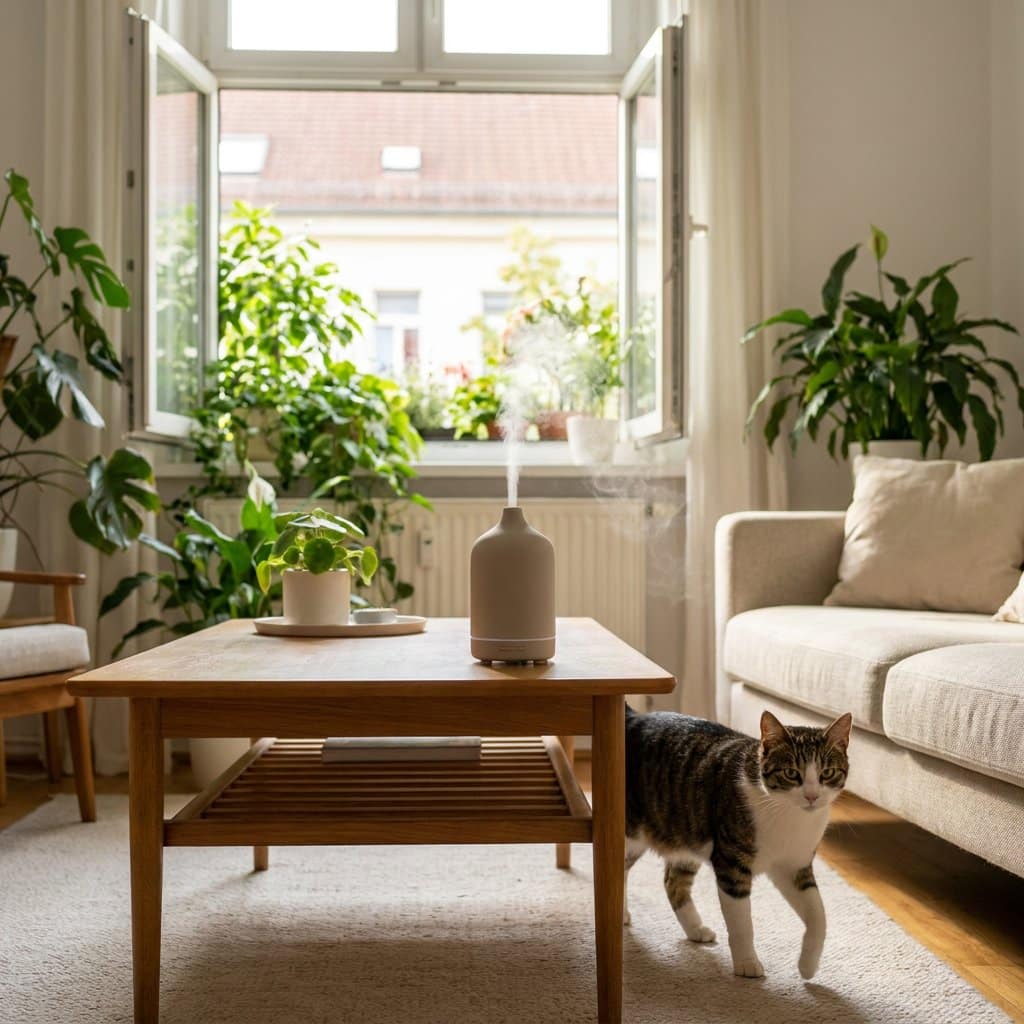

Would you like to enjoy a lovely scent at home, but do you live with a cat? If so, it’s important to take extra care. Cats are more sensitive to scents than humans, so an essential oil diffuser can only be used safely if you pay attention to your choice of oil, ventilation, duration and your cat’s behaviour.
On this page, you can find out what to bear in mind when using an aroma diffuser with cats in the house, which scents are best avoided, and how to use a diffuser as gently as possible. This will help you make an informed choice that suits both your home and your pet. Would you like to find out more? Read Connecting with animals: the power of essential oils.
Is an aroma diffuser safe for cats?
An aroma diffuser is not automatically safe or unsafe for cats. It depends on the essential oil used, the amount, the room and whether your cat is able to walk away. Cats have a keen sense of smell and may react more sensitively to scents that we perceive as mild.
That is why the safest approach is always to exercise caution: use just a few drops, ensure the room is well-ventilated, keep usage times short, and never use it in an enclosed room. Do not view the use of diffusers with cats as something you can do without restriction, but rather as something to be used consciously and sparingly.
Why cats are particularly sensitive to essential oils
Cats have a very keen sense of smell. What smells subtle to us can easily be too strong for a cat. Furthermore, certain components in essential oils can be harmful to cats. That is precisely why it is important not to base your choice on what is pleasant for you, but on safe use of essential oils for your pet.
Even if a scent is natural, that does not automatically mean it is suitable for use around cats. Natural and safe are not the same thing. A gentle, cautious approach is therefore always the starting point.
Which scents and oils are best avoided around cats?
In the case of cats, it is often advised to exercise extra caution with strong, irritating or potentially harmful oils. If in doubt, avoid using them altogether, and be particularly cautious with oils that are often cited as posing a risk in households with cats.
- Tea tree
- Eucalyptus
- Peppermint
- Citrus oils
- Cinnamon
- Clove
- Oregano
- Thyme
- Wintergreen
This list is not an invitation to automatically diffuse other oils at high concentrations. Even with oils that are considered milder, it is still important to use them with caution.
How can you use an essential oil diffuser safely when you have cats at home?
Would you still like to use a diffuser? If so, keep it simple and low-key. The following guidelines will help to minimise the risk:
- Choose a water-based diffuser for a gentler dispersion.
- Use a little oil and it’s better to start with less than with more.
- Diffuse, short, for example, a short session rather than hours on end.
- Ensure there is ventilation by leaving a window or door open.
- Make sure your cat can always get out from space.
- Do not place the diffuser too close to your cat’s sleeping spot, feeding spot or favourite resting place.
- Do not use continuously during the day.
- Keep oils and diffusers out of reach from curious paws and noses.
Are you unsure about the dosage? Read how many drops in the diffuser for a peaceful, cat-friendly start. Do you use an electric diffuser? Take a look at the Explanation of electric fragrance diffusers to select the right setting (for example, interval or low power). Would you prefer an alternative without mist? Consider passive vapour barriers (wood, plaster, felt), which are often less stimulating.
At De Groene Linde, oils for cats are only recommended for use in a diffuser or oil burner where this is specifically stated on the product. One example is Bella’s Cure Pet Rescue, for which the following applies explicitly to cats: for use in a diffuser or oil burner only. Want to find out more? Discover Bella’s Cure: a range of scents for pets.
Signs that a smell is too strong or unpleasant for your cat
Pay close attention to your cat’s behaviour both during and after diffusing. Cats sometimes show signs of discomfort in subtle ways. Stop diffusing immediately if you notice that your cat is becoming restless or is clearly trying to avoid the scent.
- Running away or hiding
- Restless behaviour or excessive meowing
- Sneezing, coughing or visible respiratory irritation
- Drooling
- Vomiting
- Lethargy or an unusual posture
Switch off the diffuser immediately, ventilate the room thoroughly and, if symptoms persist or are severe, contact your vet.
A practical guide to choosing the right option for your home
Are you unsure whether to use an essential oil diffuser around cats? If so, always err on the side of caution. Only use oils that you feel completely confident about, diffuse them for a short time, and observe your cat each time you use the diffuser. What one cat tolerates perfectly well may be too much for another.
If you’re looking for a fragrance diffuser for your home, an electric, water-based diffuser is usually the safest option. And when choosing an oil, always check the product information first. If it states that, for cats, the oil should only be used in a diffuser or with a burner, make sure you stick strictly to these instructions.
Frequently Asked Questions
Is essential oil harmful to cats?
Some essential oils can be harmful to cats, particularly if the wrong one is chosen, the dosage is too high or there is prolonged exposure. It is therefore essential to use them with caution.
Which smells are toxic to cats?
Warnings are often issued about, amongst others, tea tree, eucalyptus, peppermint, citrus, cinnamon, cloves, oregano, thyme and wintergreen. It is best to avoid using these in the home if your cat is exposed to them.
Can cats be in the same room as a diffuser?
This is only possible if the room is well ventilated, the diffuser is left on for a short time, and your cat is free to leave the room. Always keep an eye on how your cat reacts.
Is essential oil safe for pets?
This varies depending on the animal species and the type of oil. Extra care is needed with cats, as they are more sensitive to fragrances than many other pets. See also our tips on maintaining your diffuser to ensure safe and correct use.
Related articles

Samenwerking in Ontspanning en Welzijn voor de Zorg!
Stichting Massage voor de Zorg is een prachtig initiatief waar wij graag mee in verbinding zijn. Door het fijne contact met operationeel directeur Eric Both hebben wij al veel mogen...
Read more

Koshi, discover the magic of sound and nature
A gentle breeze, the sound of rippling water or the rustling of leaves. Sound can have a special effect on you. It can take you out of your head and draw your attention...
Read more

Working with Koshi’s, the magic of sound and the four elements
Perhaps you’ve experienced that moment when someone plays a Koshi. During a yoga class or some other relaxing moment. The first notes sound clear and soft, and then seem to….
Read more