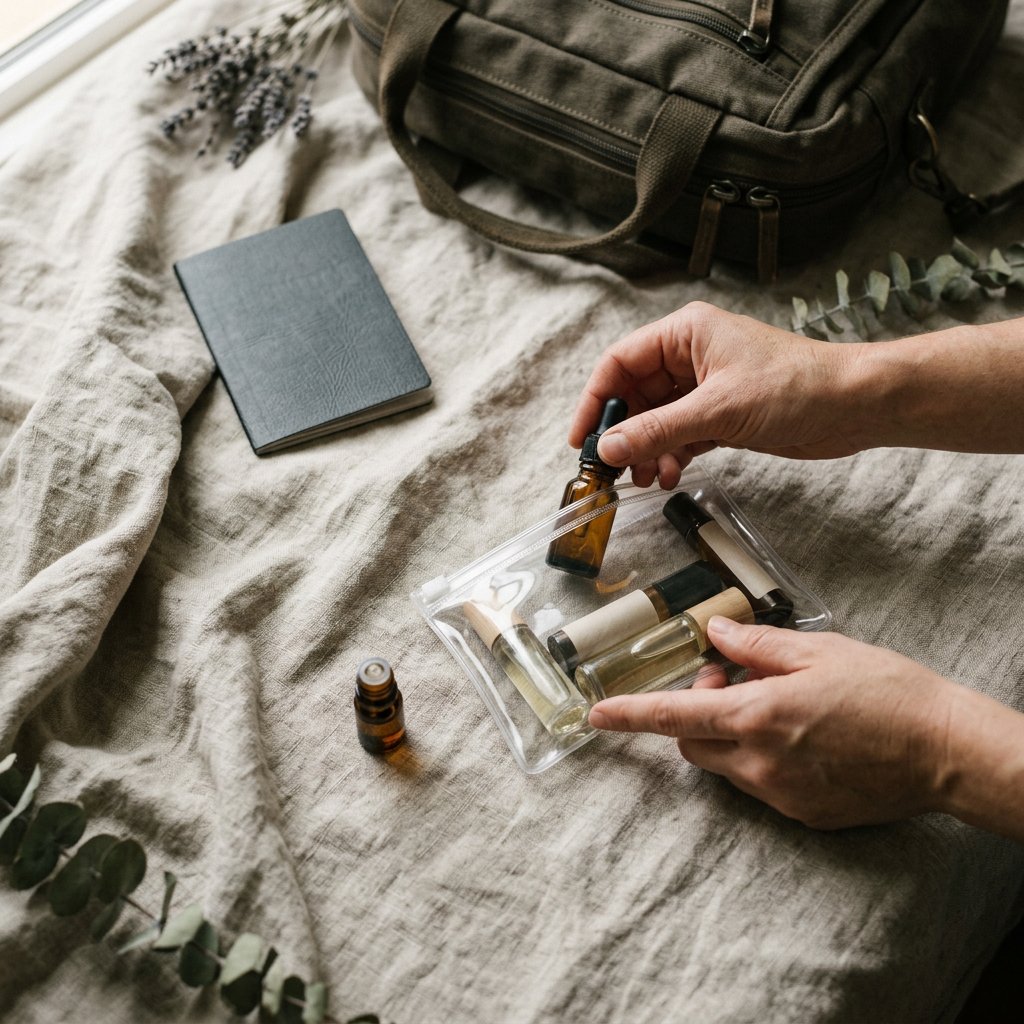

Yes, you can usually take essential oils on a plane. In your hand luggage, a small bottle is simply subject to the rules on liquids, and that’s where the strictest restrictions usually apply. There’s often more space in hold luggage, but even then, it’s still important to pack carefully.
The two main things to bear in mind are simple: take small containers with you so you can get through security without any hassle, and use perfume very sparingly whilst travelling. A small roll-on, inhaler or travel-size bottle is usually more practical than a large glass bottle or a strong fragrance in the cabin.
These are the rules regarding bottles in your hand luggage
|
Component |
Hand luggage |
Hold luggage |
|---|---|---|
|
What counts as a liquid? |
In practice, essential oils, blends, sprays and roll-ons are classified as liquids or fragrance products. |
Here too, the items in question are liquids, but the hand luggage limits do not usually apply. |
|
Basic rule |
Assume a maximum of 100 ml per pack, all placed together in a transparent bag with a capacity of approximately 1 litre. |
There’s usually more space, but always check the airline’s and airport’s current rules. |
|
Important detail |
It’s the packaging that counts, not how much is left inside. A half-empty bottle containing more than 100 ml can therefore still cause problems. |
It is still wise to seal it properly and protect it against breakage or leakage. |
How to pack your oil so it doesn’t leak and without any stress
- It’s best to choose small bottles for when you’re out and about. Travel essentials Products such as roll-ons or inhalers are often more convenient than a larger, separate bottle.
- Tighten the caps securely and pack each bottle separately, for example in a small sealable bag. This saves a lot of hassle in the event of a leak.
- Do not carry glass bottles loose at the bottom of your bag, where they could knock against other items or break.
- Keep your bag of liquids at the top of your hand luggage so that you can get it out quickly at security.
- If you’re travelling with a blend or skincare product, check the label and the size of the packaging beforehand.
Use during the flight: keep it small, subtle and personal
In an aeroplane cabin, you share the air with lots of other people in an enclosed space. What smells pleasant to you may quickly become too strong for the person sitting next to you. That is why Safety when using essential oils, for personal and occasional use, the best choice.
If you’d still like to have a fragrance to hand whilst you’re out and about, it’s best to choose a roll-on or one of the Inhalers For personal use, opt for an open bottle or spray bottle. Use it only when necessary and always be mindful of those around you.
Want to take it with you, ready-diluted? Choose Roll-ons; handy, discreet and suitable for hand luggage.
Do you suffer from a fear of flying or anxiety? Read Aromatherapy for stress for tips and scents that might help.
If you want to be extra careful
- Essential oil is highly concentrated; do not apply it carelessly to the skin, eyes or mucous membranes.
- Please bear in mind the contraindications for essential oils, for example in the case of pregnancy, breastfeeding, children, allergies or medical treatment.
- Opt for a diluted application or carry out a patch test first, if appropriate for the product.
- If you’re travelling with children, make sure you bring products that are specifically designed for their age group.
Frequently Asked Questions
What is the difference between fragrance oil and essential oil?
Essential oil is a concentrated plant extract. Fragrance oils may also contain synthetic ingredients or be formulated primarily for the purpose of providing a scent. For airport regulations, this distinction usually makes no difference: both remain liquid fragrance products. You should therefore always check the label or the INCI list so that you know exactly what you are taking with you.
How does eucalyptus affect your airways?
Many people find the scent of eucalyptus refreshing and invigorating, but this is not a medical guarantee or treatment. Moreover, on a plane, the scent can quickly become overpowering. You should therefore use it sparingly and take extra care if you have children, are pregnant or have sensitive airways, and always follow the product instructions.
Can you sleep with a diffuser on?
A diffuser isn’t practical on a plane anyway; a personal inhaler or roll-on is a better option. At home or in a hotel, always follow the instructions for your diffuser and don’t automatically set it to run all night. Not every oil is suitable for use whilst sleeping. If necessary, use a room spray to diffuse the scent. Looking for products that promote calm? Take a look at Peace & Relaxation.
How do you make essential oil?
Genuine essential oil is usually extracted by steam distillation or, in the case of some citrus peels, by cold pressing. Many DIY recipes produce a macerate or scented oil rather than pure essential oil. When travelling, this makes little difference in terms of luggage regulations: a liquid is still a liquid.
Related articles
Orthoceras, the ancient wisdom of the Earth
Some stones carry a story that is far older than humankind. A story that can be clearly felt in the stone’s energy. The Orthoceras fossil is...
Read more

Working Together for Relaxation and Wellbeing in the Care Sector!
The Massage for Care Foundation is a wonderful initiative that we are delighted to be associated with. Thanks to our excellent relationship with the operational director, Eric Both, we have already been able to…
Read more
Koshi, discover the magic of sound and nature
A gentle breeze, the sound of rippling water or the rustling of leaves. Sound can have a special effect on you. It can take you out of your head and draw your attention...
Read more