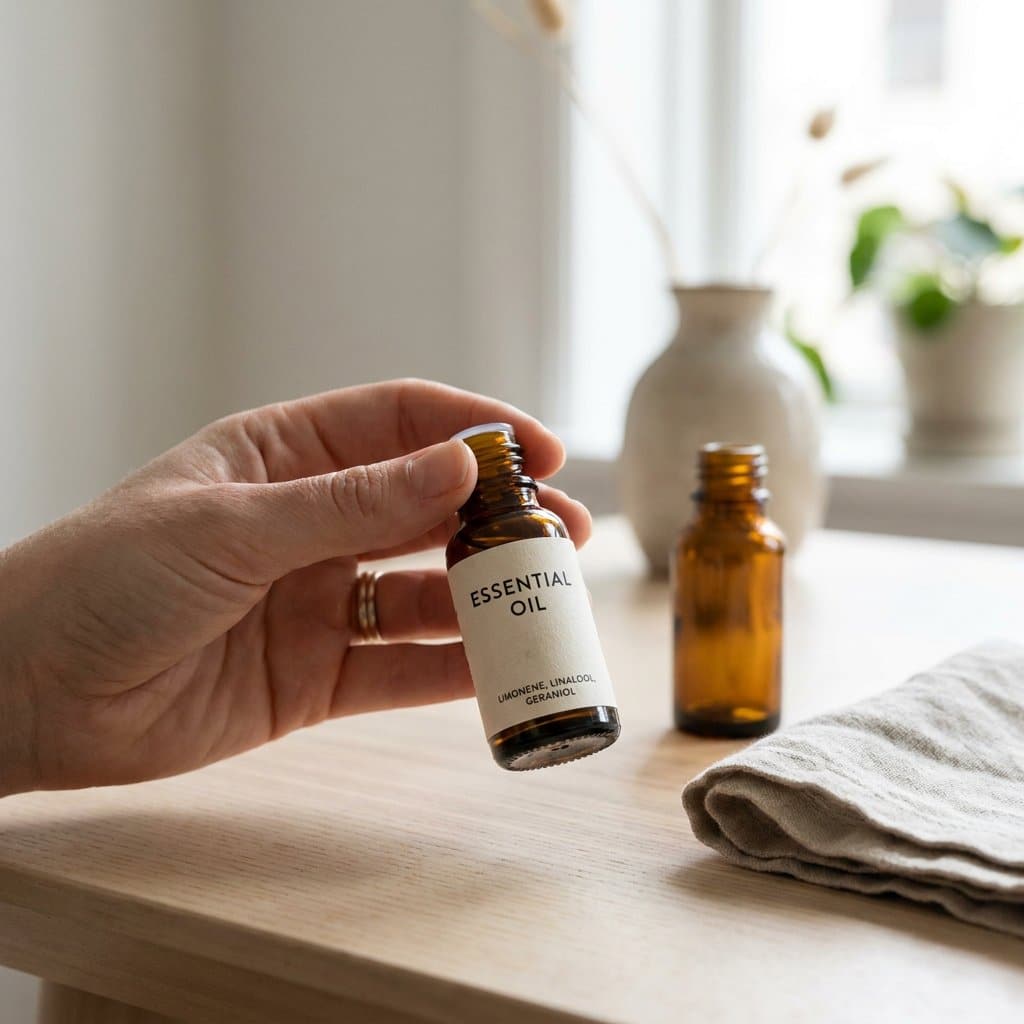

Allergens on the label of an essential oil
Do you see names such as limonene, linalool, geraniol or citral on the label of an essential oil or a skincare product? If so, these are fragrance allergens: fragrances that may occur naturally in essential oils and therefore sometimes need to be listed separately on the label. This doesn’t automatically mean that a product is unsafe, but it does mean you should be extra careful when choosing one if your skin is prone to reactions. Understanding the difference between essential oils and fragrance oils can also help here.
Especially if you’re sensitive to perfume, tend to get redness or itching easily, or have had reactions in the past, it’s a good idea to take the time to learn how to read labels properly. Below, we explain in practical terms where to find allergens, what those ingredient names mean, and what to look out for in pure essential oils and cosmetics containing essential oils.
What those ingredient names on the label really mean
Allergens listed on the label are usually not “additives”, but individual fragrance compounds that are naturally present in an essential oil. For example, citrus oils often contain limonene, lavender oil often contains linalool, and rose-like scents may contain geraniol. Precisely because essential oils are 100% naturally pure and highly concentrated, these components may be clearly detectable.
These names are listed on the label so that you can more easily identify which ingredients you may be sensitive to. This is particularly useful if you have sensitive skin, a perfume allergy, or if you use several products that contain the same fragrances.
Where can you find allergens on the label?
Where you look depends on the type of product. For skincare products, allergens are usually listed in the ingredients list. For pure essential oils, you’ll sometimes find the relevant information partly on the label and partly in the product specification or in our article on safe use of essential oils.
|
Product type |
Where are you looking? |
What do you usually see? |
|---|---|---|
|
Cosmetics containing essential oils |
INCI ingredients list, often at the end |
Individual names such as limonene, linalool, citral and eugenol |
|
Pure essential oil |
Label, product page and product specification |
Botanical name, batch, warnings, and sometimes relevant ingredients |
|
Professional use |
SDS, COA or product data sheet |
Current composition, batch-by-batch analysis and safety information |
In the case of cosmetics, fragrance allergens that exceed the legal limit must be listed on the label. Online, you will still often come across the old list of 26 fragrance allergens, but that European list has been expanded. As a result, you will see more individual fragrance allergens listed on newer labels than before.
For up-to-date analyses, SDSs and batch information, you can find the relevant documentation on our certificates.
Common allergens in essential oils
There are a few names you’ll come across particularly often. These aren’t “bad” substances, but they are substances to which some people are sensitive:
- Limonene – is commonly found in citrus oils such as orange, lemon and grapefruit.
- Linalool – often found in lavender, ho wood and other floral or soft scents.
- Citral – characteristic of fresh, lemony oils such as lemongrass and litsea.
- Geraniol – is more commonly found in rose-like and floral fragrance profiles.
- Eugenol – is found in essential oils such as clove oil.
Important to note: a label bearing these names does not necessarily mean you will have a reaction. It simply indicates that these known fragrance allergens are present and that you should take this into account when making your choice.
Why you might still have a reaction to a completely natural oil
Just because an oil is natural does not automatically mean that it is always gentle. Essential oil is a highly concentrated plant extract. Your skin may react due to personal sensitivity, excessive dosage, use in undiluted form, or because the same fragrance is present in several products at the same time.
Batch variations also play a part; read more about batch-to-batch variations in essential oils. Essential oil is a natural product, so its composition and the concentration of certain constituents may vary slightly from one harvest or batch to another. In addition, some substances, such as limonene and linalool, may become more irritating to the skin as a result of oxidation. It is therefore important to store it correctly: in a dark, cool place and in a tightly sealed container. Read more about shelf life of essential oil.
Furthermore, not every reaction is a classic allergic reaction. Some citrus oils, such as bergamot, can be phototoxic. If you apply such an oil to your skin and then go out into the sun or under UV light, this can cause skin reactions. This is different from an allergic reaction, but it is just as important to bear in mind.
How to read a label, step by step
- First, check whether it is a pure essential oil or a cosmetic product.
- Look for individual names such as limonene, linalool, citral or geraniol in the list of ingredients.
- Compare them with substances you’ve reacted to in the past. If necessary, keep a list for yourself.
- Please also take note of warnings regarding skin contact, dilution and sunlight.
- If in doubt, first test a diluted solution on a small patch of skin and stop immediately if irritation occurs.
Are you unsure about the correct dosage or how to use it? Find out more about How to dilute essential oil safely.
Do you tend to experience redness, itching or a burning sensation easily? If so, choose carefully, don’t use too much at once, and ask for personalised advice if you’re not sure which oil is right for your skin.
Frequently Asked Questions
What is the list of allergens?
This is the official list of fragrance allergens that must be listed on cosmetic labels if they are present in concentrations exceeding the legal limit. Many people are still familiar with the old list of 26, but those rules have been expanded. That is why you may come across more individual substance names on modern labels.
Are allergens always listed at the end of the ingredients list?
This is often the case with cosmetics, as they are usually present in small quantities and are listed separately. However, this isn’t a hard and fast rule for every product. You should therefore always check the full list of ingredients if you have sensitive skin.
Which oils should you avoid using without good reason during pregnancy?
Not every essential oil is automatically safe to use during pregnancy. It depends on the oil, the dosage, the method of application and your personal circumstances. During this time, it is best to use only products that come with clear safety information and, if in doubt, ask us for advice. Read more about Contraindications for the use of essential oils.
Can you be allergic to tea tree oil?
Yes, you can. Tea tree oil is well tolerated by many people, but it can cause irritation or an allergic reaction in others, particularly when used undiluted or if the oil has gone off. So always use it with care, preferably diluted, and stop using it if your skin reacts.
What should you do if you experience redness or itching after use?
Stop using the product immediately and do not use it again until you know what you have reacted to. Gently wash the product off your skin if appropriate for the application, avoid further exposure and, if in doubt or if you experience a severe reaction, consult a doctor. If you frequently experience reactions to fragrances, it is advisable to check future product labels carefully.
At De Groene Linde, we believe that making informed choices starts with clear information. If you work with 100% naturally pure essential oils, blends or scent frequencies, a carefully read label will help you use them with greater peace of mind, safety and confidence. If you have any doubts about a specific oil or the list of ingredients, we’d be happy to help you sort it out.
Related articles

Samenwerking in Ontspanning en Welzijn voor de Zorg!
Stichting Massage voor de Zorg is een prachtig initiatief waar wij graag mee in verbinding zijn. Door het fijne contact met operationeel directeur Eric Both hebben wij al veel mogen...
Read more

Koshi, discover the magic of sound and nature
A gentle breeze, the sound of rippling water or the rustling of leaves. Sound can have a special effect on you. It can take you out of your head and draw your attention...
Read more

Working with Koshi’s, the magic of sound and the four elements
Perhaps you’ve experienced that moment when someone plays a Koshi. During a yoga class or some other relaxing moment. The first notes sound clear and soft, and then seem to….
Read more