
How are crystals formed?
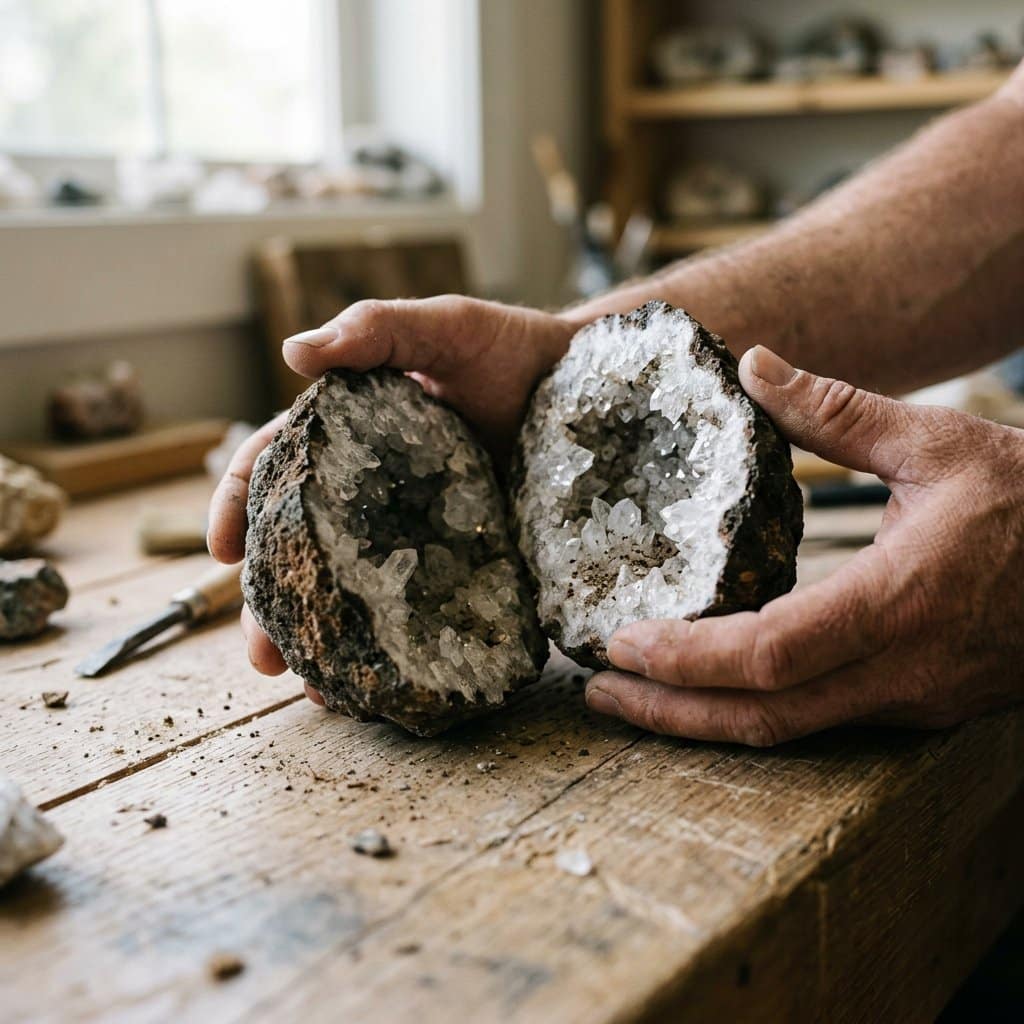
Crystals form when atoms, ions or molecules arrange themselves into a fixed, repeating structure under the right conditions. In nature, this occurs mainly in three ways: from cooling magma, from mineral-rich water, or as a result of existing rock being transformed by heat and pressure. That basic principle is always the same, but the timescale is not: in a simple experiment at home, you can sometimes see results within days, whilst natural crystal formation often takes place very slowly.
From individual particles to a crystal lattice
The short answer to the question of how a crystal forms is simple: individual particles begin to arrange themselves into a fixed pattern, a crystal lattice. For this to happen, the conditions must be just right – for example, through cooling, evaporation, pressure or a high concentration of dissolved substances. Where crystals come from therefore depends on their environment. Visible, beautiful shapes mainly form when a crystal is given enough time and space to grow undisturbed.
Where that growth takes place in nature
Crystals and gemstones do not form in just one place or in just one way. They usually originate in solidifying magma, in mineral-rich water or in existing rock that undergoes changes deep within the Earth’s crust. In all these environments, the particles organise themselves, but temperature, pressure, depth and time determine which mineral forms and how large or visible the crystals ultimately become – something that is often clearly evident in rough crystals.
When magma cools slowly
When magma cools, the minerals it contains change from a liquid to a solid state and form crystals. If this process takes place slowly, deep within the Earth, there is more time for growth and the crystals can become larger. When cooling occurs rapidly, for example following volcanic activity, the crystals often remain smaller. This results in igneous rock in which crystals are sometimes clearly visible and sometimes retain a very fine structure.
When minerals precipitate out of water
Crystals can also form from water in which minerals are dissolved. If the water evaporates, cools down or changes composition, those minerals can precipitate and crystallise. This happens, for example, in cracks in rock, in caves, lakes and other depositional environments. Calcite and rock crystal are well-known examples of this; if you’d like to see more varieties, take a look at our A to Z guide to crystals. This shows that crystals do not only form from magma, but can also form from mineral-rich water.
When rock changes due to heat and pressure
Sometimes a new crystal structure does not form from molten rock or evaporating water, but from rock that already existed. Under extreme heat and pressure, deep within the Earth’s crust, minerals can rearrange themselves and recrystallise. This is called metamorphism: the original material changes in structure and sometimes also in appearance. In this way, new crystals can form within existing rock that are suited to these new conditions.
In addition to these main processes, there are also special cases in which high energy plays a role, such as in the event of impacts from space. A well-known example is tektite (formed by a meteorite impact), which is caused by extreme heat and pressure during an impact.
Crystal, mineral, gemstone or stone: what’s the difference?
These terms are often used interchangeably. In short:
|
Concept |
What it means |
|---|---|
|
Crystal |
A solid in which the particles are arranged in a regular, repeating pattern. |
|
Mineral |
A naturally occurring substance with its own composition and structure; many minerals form crystals. |
|
Rock or stone |
A mixture of one or more minerals. A rock is therefore often made up of several minerals combined. |
|
Gemstone |
Not formed in any particular way, but usually a mineral or rock that is prized for its rarity, colour, clarity, hardness or practical value. |
|
Raw or processed |
Raw pieces, clusters and geodes show natural growth. Tumbled stones and polished pieces have been worked on after formation. That is why you often see both forms in a crystal collection. |
|
What is the most expensive crystal? |
There is no simple, fixed answer to that: the price depends on rarity, clarity, colour, size and any treatment or processing. |
Would you like to put this into practice? Identifying gemstones? This guide will help you get started, step by step.
If you work with crystals, start with the basics: Cleaning and recharging crystals for a good, refreshing burst of energy.
Why you can grow crystals yourself using salt, sugar or alum
- In a crystal experiment, the basic principle is the same as in nature: dissolved particles rearrange themselves as soon as the conditions change.
- When using salt, sugar or alum, you’ll often see results within a few days to about one to two weeks – much faster than natural crystallisation.
- The main difference lies in the complexity: a beaker of solution is straightforward, whereas in nature, pressure, temperature, depth and mineral-rich water also play a part.
- If you’d like to have a go yourself, make sure you work carefully and safely: use clean materials and always allow hot liquids to cool down before carrying on.
Curious about how to use crystals Now that you know how they’re formed, why not discover some practical applications and tips?
Related articles
Orthoceras, the ancient wisdom of the Earth
Some stones carry a story that is far older than humankind. A story that can be clearly felt in the stone’s energy. The Orthoceras fossil is...
Read more

Working Together for Relaxation and Wellbeing in the Care Sector!
The Massage for Care Foundation is a wonderful initiative that we are delighted to be associated with. Thanks to our excellent relationship with the operational director, Eric Both, we have already been able to…
Read more

Koshi, discover the magic of sound and nature
A gentle breeze, the sound of rippling water or the rustling of leaves. Sound can have a special effect on you. It can take you out of your head and draw your attention...
Read more