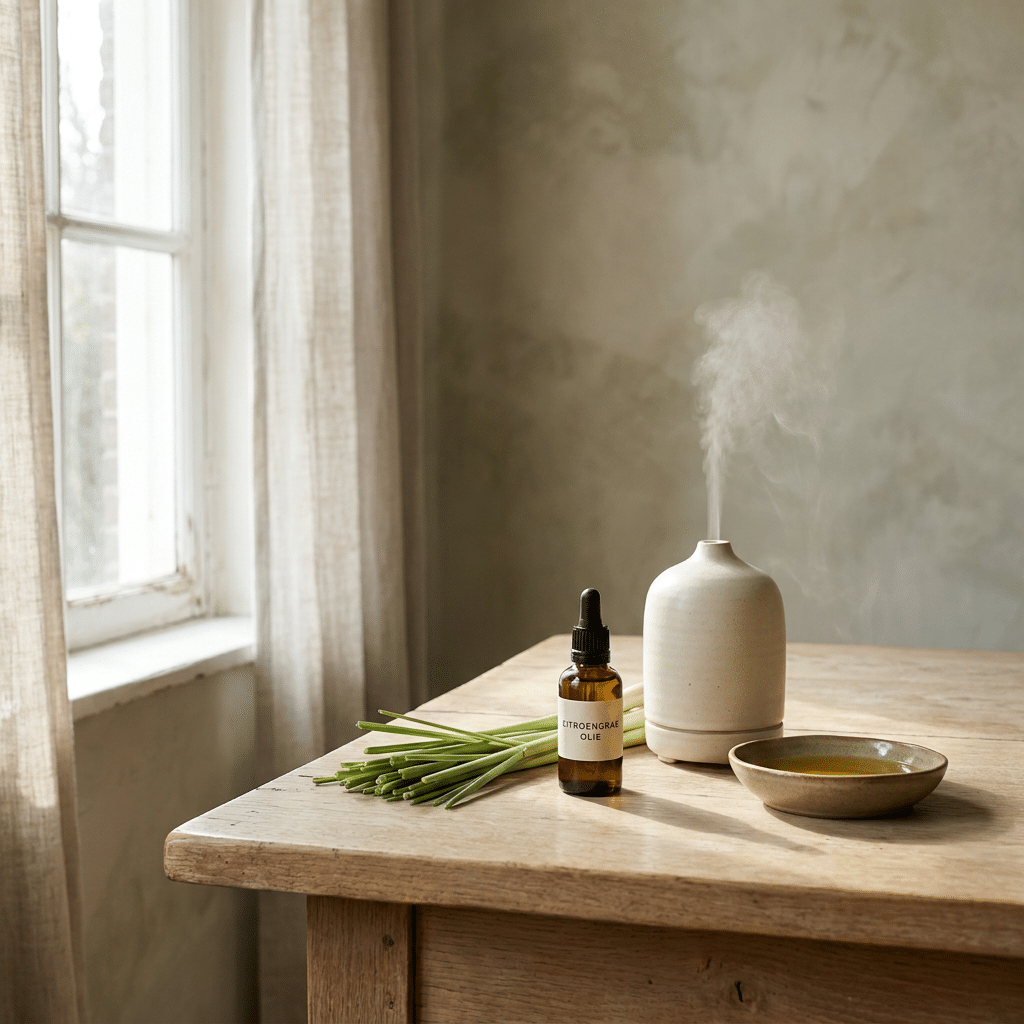

Lemongrass oil has a fresh, lemony scent with a green and herbaceous undertone. Many people use this essential oil in a diffuser, on a fragrance stone or diluted in massage oil. Would you like to know exactly what lemongrass oil is, how its scent is usually experienced and how to use it safely? We explain it clearly and practically below.
Fresh, spicy and different from lemon oil
Lemongrass essential oil, also known as lemongrass oil … is usually extracted from plants of the genus Cymbopogon, such as Cymbopogon citratus or Cymbopogon flexuosus. The oil is usually extracted from the grass or leaves by steam distillation.
The scent is distinctly fresh, citrusy and green. However, lemongrass oil is not the same as lemon oil. Lemon essential oil comes from the peel of the lemon fruit, whilst lemongrass oil is extracted from a type of grass. If you’re looking for a bright, lively scent for your home, lemongrass is often a lovely choice. Take a look at the Citrus fragrance profile for fresh, similar scents.
How to use lemongrass oil in practice
Lemongrass oil is mainly used for fragrance applications and for diluted use on the skin. Always use a small amount and follow the instructions on your product’s label.
| Application | How to use it | Please note the following |
|---|---|---|
| Diffuser | Add a few drops to the water reservoir in accordance with your diffuser’s instructions. | Start off gently, so that the scent doesn’t become too overpowering in the room. |
| Scent stone or scent pendant | Apply 1 to 3 drops to the stone or pendant and let the scent evaporate gently. | Ideal for smaller spaces such as a toilet, hallway or workspace. |
| Massage oil or skin oil | Always dilute the oil in a carrier oil, such as almond or jojoba oil, first. | Never apply lemongrass undiluted to the skin; test it on a small area first. |
Want to find out more about dosing? Read: How many drops should I put in the diffuser?
Fancy mixing some scents? Lemongrass often blends beautifully with, for example, lavender, eucalyptus, peppermint or subtle citrus notes. It’s better to keep a blend simple rather than too rich. That way, the fresh, natural scent remains nicely balanced. See also: Mixing essential oils for your diffuser.
Using lemongrass essential oil safely
Lemongrass is a potent essential oil. That is precisely why it is important to use it with care. Especially when applied to the skin, this oil can quickly become too intense if it is not properly diluted.
- Do not apply lemongrass oil undiluted to the skin; always dilute it in a suitable carrier oil.
- Avoid contact with the eyes, mucous membranes and sensitive or damaged skin.
- Do not ingest essential oil.
- If you have sensitive skin, carry out a patch test on a small area of skin first.
- Take extra care when using this product during pregnancy, whilst breastfeeding, around young children and pets. If in doubt, seek personal advice.
- Keep the bottle tightly closed, in a cool place and out of the reach of children.
For detailed advice on who should (temporarily) avoid certain activities or take extra care, please read: Contraindications and safety.
Many people search for the effects of lemongrass essential oil. Usually, they are referring to the effect of the scent. This is often described as refreshing, crisp and invigorating. You should therefore not regard lemongrass oil as a medicine, but as a natural fragrance product to be used mindfully and with care.
Frequently asked questions about lemongrass oil
Is lemongrass the same as citronella?
Yes. Lemongrass is simply the English name for citroengras. You’ll often see both names on packaging, sometimes along with the Latin name of the plant.
What is lemongrass oil used for?
The most common uses are in a diffuser, on a fragrance stone, and diluted in massage or skin oil. The fresh scent is often chosen for the living room, workplace or bathroom.
What are the effects of lemongrass oil?
By ‘effect’, people usually mean how the scent makes them feel. Lemongrass oil is often perceived as fresh, light and invigorating. This makes it a popular choice in fragrance blends designed to create a clean and lively atmosphere.
What should you look out for when buying lemongrass oil?
Look out for the Latin name, the statement that it is a 100% pure essential oil, a clear list of ingredients and clear warnings regarding use. A good lemongrass oil is usually packaged in dark glass and is not a synthetic fragrance oil. At De Groene Linde, we consider transparency, pure natural ingredients and clear product information to be of the utmost importance. Would you like to compare products and place an order quickly? Go to Lemongrass and other single essential oils (A–C).
Related articles

Koshi, discover the magic of sound and nature
A gentle breeze, the sound of rippling water or the rustling of leaves. Sound can have a special effect on you. It can take you out of your head and draw your attention...
Read more

Working with Koshi’s, the magic of sound and the four elements
Perhaps you’ve experienced that moment when someone plays a Koshi. During a yoga class or some other relaxing moment. The first notes sound clear and soft, and then seem to….
Read more
Happy Autumn: turning inwards, letting go and enjoying the moment
Autumn is here. Whilst for some it means cosiness, for others autumn can evoke a completely different feeling. And with that different feeling, I am...
Read more