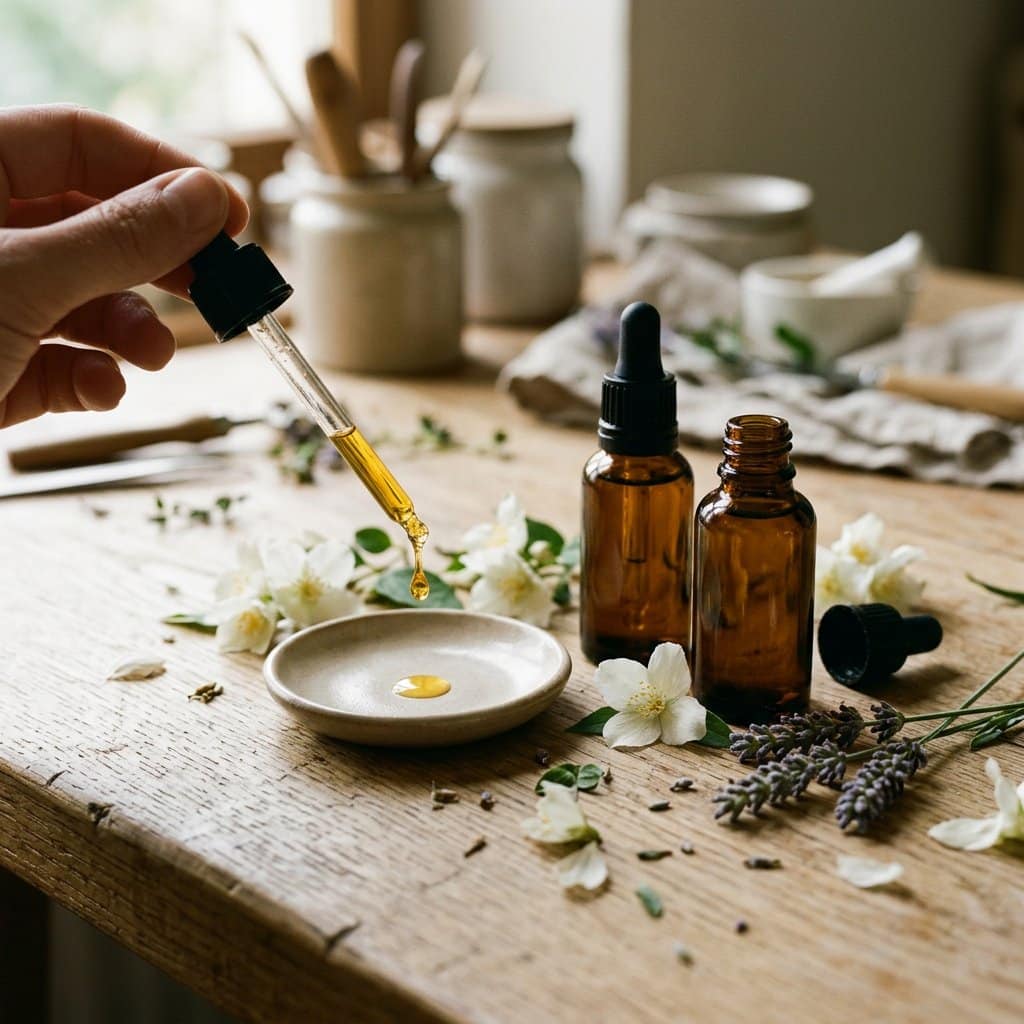

The difference between absolute and essential oil
The short answer: an essential oil is usually obtained through steam distillation or, in the case of citrus fruits, cold pressing. An absolute is usually produced through solvent extraction. Consequently, they are not two names for the same product, but two different types of aromatic plant extracts.
In practice, you’ll notice this mainly in the scent and how it’s used. An absolute often has a fuller, deeper and less volatile scent, which is why it’s more commonly found in perfumery. Essential oils are better known for diffusion and diluted aromatic use. On our website, you’ll therefore mainly find essential oils, carrier oils, roll-ons and fragrance diffusers.
At a glance: here’s how they differ
|
Characteristic |
Single oils |
Absolue |
|---|---|---|
|
Winning |
Usually steam distillation or cold pressing |
Usually solvent extraction |
|
Plant material |
Bark, leaf, wood, root, resin, flower |
Often delicate flowers or fragrant materials |
|
Texture |
Often thin and fleeting |
Often fuller-bodied, richer and sometimes more viscous |
|
Fragrance profile |
Lighter and fresher |
Deeper and rounder |
|
Important to know |
Natural aromatic extract |
Not “stronger”, but a different type of extract |
What exactly is an essential oil?
An essential oil is a concentrated plant extract consisting of volatile aromatic compounds. It is therefore not a fatty carrier oil such as almond or jojoba oil. Essential oils can be derived from various parts of plants, such as the peel, leaves, wood, root or flower. The most commonly used extraction methods are steam distillation and, in the case of citrus fruits, cold pressing. As the end product is highly concentrated, it is normally used drop by drop. Read more about how essential oil is made.
What absolute precision is
An absolute is often made from delicate flowers or other fragrant plant material that is difficult to distil. This usually involves two steps: first, a concrete is produced using a solvent; then, the fragrant material is further separated using alcohol to produce the absolute. The result often smells richer, deeper and less volatile than an essential oil. That is why you see absolutes more often in perfumery than amongst the essential oils and blends that you mainly find here. A well-known example is jasmine; read more about using jasmine oil.
Why the way you win matters so much
The method used to extract an essence determines which aromatic compounds are ultimately retained. This is because heat, pressure and solvents do not extract exactly the same components from a plant. Steam distillation often yields a clear, volatile aromatic profile. With cold pressing, as is the case with citrus fruits, it is mainly the scent from the peel that is retained. Some flowers, on the other hand, release only part of their character during distillation, which is why they are more commonly found as absolutes. Solvent extraction can then yield a fuller fragrance. In addition, there are also CO₂ extracts, which form a category of their own. This extraction method is reflected not only in the scent, but also in the colour, texture and often the price: the more difficult the extraction and the lower the yield, the more expensive the extract usually is.
When would you be more likely to choose one over the other?
- It is better to choose an essential oil if you want to use it in a diffuser, in an inhaler, or to make a diluted preparation using a carrier oil. This is the form most people are familiar with for home aromatherapy use.
- It’s better to choose an absolute if you’re primarily looking for a deep, luxurious fragrance note for a perfume or fragrance composition. That’s where its richer, less volatile character often comes into its own.
- When considering price and availability, don’t just focus on the word “quality”. At How to recognise pure essential oil Yield per plant, the rarity of the material and the extraction method all play at least as significant a role.
- A stronger or more intense scent does not automatically mean that a product is better, or more suitable for the way you use it.
How to use them safely on your skin and in your diffuser
- Can you apply essential oil to your skin? Usually not in its pure form. Dilute it first with a suitable carrier oil and follow the guidelines for How to dilute essential oil safely.
- An absolute is also highly concentrated. It is therefore not automatically milder or safer for direct application to the skin.
- When using on the skin, carry out a patch test first, use sparingly and take extra care with children, during pregnancy and around pets.
- At De Groene Linde, internal use is not our standard recommendation. An essential oil is a highly concentrated product, which means that internal use can cause harm.
Frequently Asked Questions
What is the difference between essential oil and perfume oil?
Essential oil is a natural plant extract. Fragrance oil is usually a fragrance blend that may also contain synthetic or diluted ingredients. This ties in with the difference between essential oil and fragrance oil. Perfume oil is primarily designed to provide a scent experience and therefore does not have the same composition as essential oil. An absolute is something else again: it is also a natural extract, but is obtained using a different method to that used for traditional essential oils.
Do essential oils really work?
Many people find that scent helps to create a pleasant atmosphere, promote relaxation or foster a moment of mindfulness. How you experience this does, however, vary greatly from person to person. Quality, dilution, method of use and your own expectations all play a part in this. Essential oils should therefore be seen primarily as a support within a fragrance or self-care ritual, not as a substitute for medical treatment or professional advice.
Related articles

Orthoceras, the ancient wisdom of the Earth
Some stones carry a story that is far older than humankind. A story that can be clearly felt in the stone’s energy. The Orthoceras fossil is...
Read more

Working Together for Relaxation and Wellbeing in the Care Sector!
The Massage for Care Foundation is a wonderful initiative that we are delighted to be associated with. Thanks to our excellent relationship with the operational director, Eric Both, we have already been able to…
Read more

Koshi, discover the magic of sound and nature
A gentle breeze, the sound of rippling water or the rustling of leaves. Sound can have a special effect on you. It can take you out of your head and draw your attention...
Read more