
The heart chakra, also known as anahata, represents love, compassion and connection. It forms the bridge between what you feel and how you share that with yourself and others. When this energy centre is in balance, you are more likely to experience gentleness, trust and the space to both give and receive love.
Many people look for information about the heart chakra because they feel closed off, hurt or out of balance. In such cases, it helps to first understand what the heart chakra does, how a blockage might manifest itself, and what simple exercises you can do at home to experience greater peace and openness.
What does your heart chakra do?
The heart chakra is the fourth chakra and is situated in the centre of the chest, at the level of the heart. In chakra theory, this centre is regarded as the realm of connection, compassion, forgiveness and inner harmony. It also acts as the link between the lower chakras, which are more concerned with grounding, security and willpower, and the higher chakras, which focus more on insight, expression and spirituality.
In practical terms, the heart chakra is about how freely you can love without losing yourself. It’s about self-love, healthy closeness, empathy, trust and the ability to remain open, even when you’ve been hurt. An open heart doesn’t mean you always let everything in. In fact, a healthy heart chakra helps you to be both warm and clear.
Characteristics of a balanced heart chakra
When your heart chakra feels balanced, you often notice this in your relationships, your self-image and your emotional resilience. You then feel less need to protect yourself or prove yourself.
- You can give love without putting yourself last
- You can receive love without mistrust or feelings of guilt
- You feel more compassion for yourself and for others
- You’re not afraid to be vulnerable, whilst maintaining healthy boundaries
- You’ll find it easier to recover from disappointment or sadness
- You’ll feel more calm in your chest area and in your breathing
Balance doesn’t mean that you’re always light-hearted or carefree. Above all, it means allowing your feelings to flow, without letting them completely shut you off or overwhelm you.
Recognising an unbalanced heart chakra
An out-of-balance heart chakra can manifest emotionally, mentally and sometimes physically too. Think of difficulties with trust, fear of commitment, people-pleasing behaviour or, conversely, keeping others at a distance. Some people give a lot, but find it difficult to receive. Others quickly feel rejected or unconsciously put up a wall around themselves.
Common signs
- Difficulty with intimacy, connection or accepting support
- Fear of rejection or abandonment
- Jealousy, bitterness or old sorrows that linger
- Changing who you are to keep love or approval
- A feeling of being cut off or emotional numbness
- Tension in the shoulders, upper back or chest area
- Shallow breathing or the feeling that you’re short of space
These signs do not necessarily have anything to do with chakras. They may also have other causes. You should therefore see them primarily as an invitation to pay attention and tune into what is going on inside you.
What causes the heart chakra to become blocked?
A blockage in the heart chakra is often linked to experiences that have touched your heart. These can be major and life-changing, such as loss, rejection or heartbreak, but they can also be more subtle. For example, if you have spent a long time learning to bottle up your feelings, to stay strong or, above all, to look after others.
Common causes include:
- unresolved grief or disappointment
- lack of emotional security
- rejection or feeling that your needs are not being met
- finding it hard to forgive, whether yourself or someone else
- long-term stress, overwork or perfectionism
- old patterns of people-pleasing or self-criticism
In spiritual traditions, it is sometimes said that old pain or trauma can become lodged in the heart chakra. You can see this as a symbolic way of describing how grief, loss and betrayed trust are still tangibly present within your system. The most important thing is not the term itself, but whether you recognise that your heart has started to build up a defence mechanism.
What does it feel like when your heart chakra opens?
An opening heart chakra rarely feels like one single, momentous event. More often, it is a gradual process in which you experience greater gentleness, space and authenticity. Sometimes you may notice that you breathe more easily, are moved more quickly, or find it easier to speak openly about how you really feel.
At the same time, opening up can also be temporarily uncomfortable. Old emotions may resurface, precisely because you are suppressing them less. Crying, tiredness, a need for silence or the realisation that you need to learn to recognise your boundaries again can all be part of this process. That does not automatically mean that something is wrong. In fact, it may be a sign that things are starting to move again.
Opening the heart chakra with simple exercises
Opening your heart chakra doesn’t have to be complicated. Small, repeatable rituals often work better than something grand and one-off. Above all, choose whatever feels safe and achievable for you.
1. Breathing into the heart area
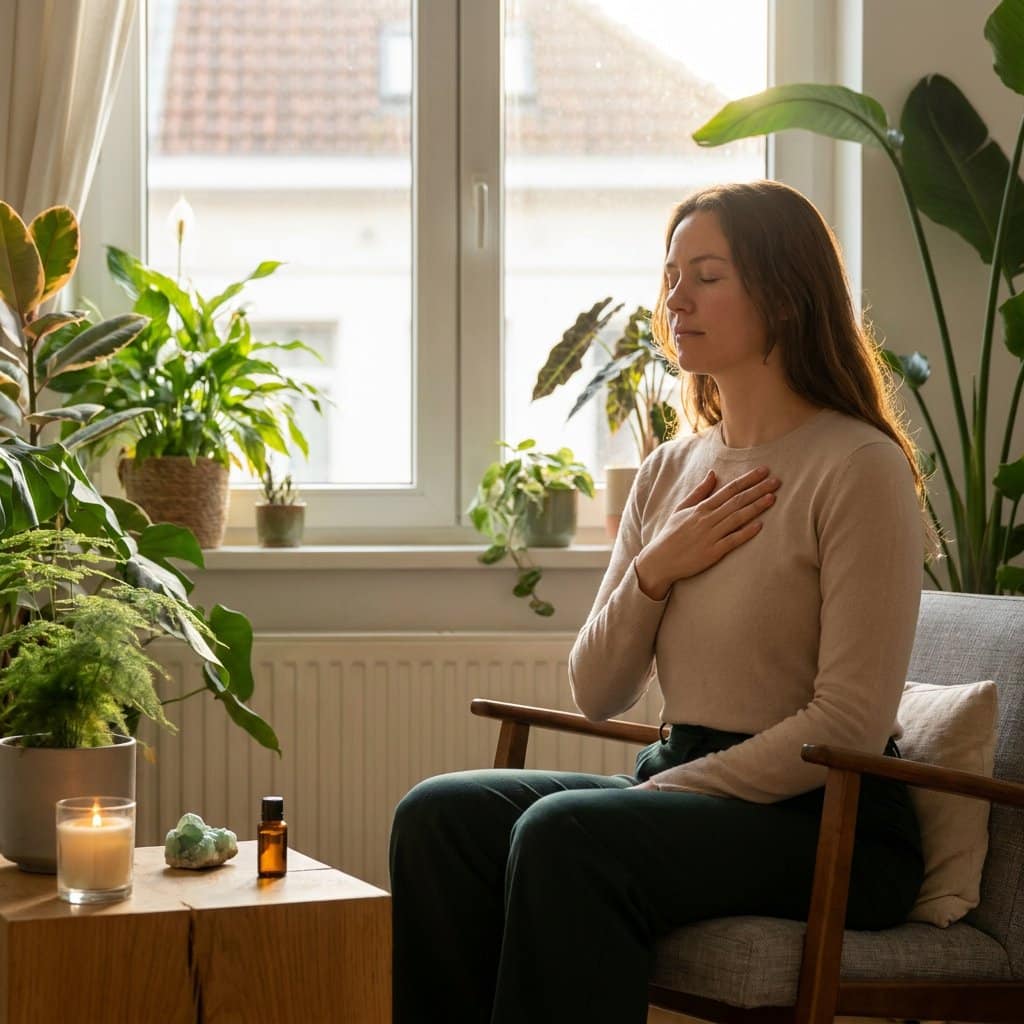
Sit down comfortably and place one hand on your chest. Breathe in slowly through your nose and consciously let your breath flow into the area around your heart. Breathe out for longer than you breathe in. Do this for a few minutes and notice how you feel, without forcing anything.
2. Meditation using the colour green
As you breathe, visualise a soft green colour in your chest area. Imagine that with every inhalation, more space is created, and that with every exhalation, tension eases slightly. This exercise is often used because green is traditionally associated with the fourth chakra (heart chakra).
3. Mantra for the heart chakra
The mantra associated with Anahata is YAM. You can say it softly or repeat it silently during meditation. The rhythm of the repetition helps many people to experience greater focus and calm.
4. Heart-opening movement
Open your arms, relax your shoulders and lift your sternum very gently whilst breathing deeply. Gentle yoga poses that open up the chest, such as the bridge pose or the cobra pose, can also be helpful if you have experience with them and listen carefully to your body.
5. Writing from a place of self-compassion
Spend a few minutes writing down, without holding back, what your heart needs. Not what you think you should feel, but what’s really going on. This exercise helps you to be kinder to yourself and to listen more honestly.
The symbolism of Anahata
There are a few characteristics that often recur in connection with the heart chakra:
- Colour: green
- Element: air
- Mantra: YAM
- Topics: love, connection, compassion, forgiveness and harmony
This symbolism can help to bring focus to meditation or rituals. Think of it as a guide, not a hard and fast rule. What matters most is what helps you to experience greater peace, openness and connection.
Natural support in a heart chakra ritual
If scents or crystals form part of your self-care routine, you can use them as an anchor in your ritual. At De Groene Linde, you’ll find products relating to this theme, including Heart Chakra (Anahata) as an aura spray and essential oil, a chakra rollers, crystals that are explicitly associated with the heart chakra, such as green aventurine and rose quartz, and our love & compassion – oils.
You could use a product like this, for example, whilst meditating, doing a breathing exercise or taking a quiet moment to yourself. Not as a quick fix, but as a gentle aid to help you consciously focus on love, peace and connection.
FAQ on the heart chakra
What traumas are stored in the heart chakra?
Within spiritual and energetic traditions, the heart chakra is often associated with sadness, rejection, loss, heartbreak and betrayed trust. Please do not view this as a medical statement, but rather as a way of understanding why certain emotional experiences can linger for a long time.
What are the symptoms of a blocked heart chakra?
Commonly cited signs include difficulty accepting love, keeping others at a distance, mistrust, people-pleasing behaviour, fear of rejection, emotional numbness and tension in the chest or shoulders. The intensity varies from person to person.
How can you feel your heart chakra?
This often begins by focusing on your breath, your chest area and your emotions. By sitting quietly, placing your hand on your heart and observing without judgement, you’ll notice more quickly whether there is space, tension, softness or, conversely, a sense of closure.
What colour is the heart chakra?
The colour of the heart chakra is green. In many traditions, green symbolises growth, balance, healing and a connection with nature.
Related articles
Koshi, discover the magic of sound and nature
A gentle breeze, the sound of rippling water or the rustling of leaves. Sound can have a special effect on you. It can take you out of your head and draw your attention...
Read more

Working with Koshi’s, the magic of sound and the four elements
Perhaps you’ve experienced that moment when someone plays a Koshi. During a yoga class or some other relaxing moment. The first notes sound clear and soft, and then seem to….
Read more
Happy Autumn: turning inwards, letting go and enjoying the moment
Autumn is here. Whilst for some it means cosiness, for others autumn can evoke a completely different feeling. And with that different feeling, I am...
Read more