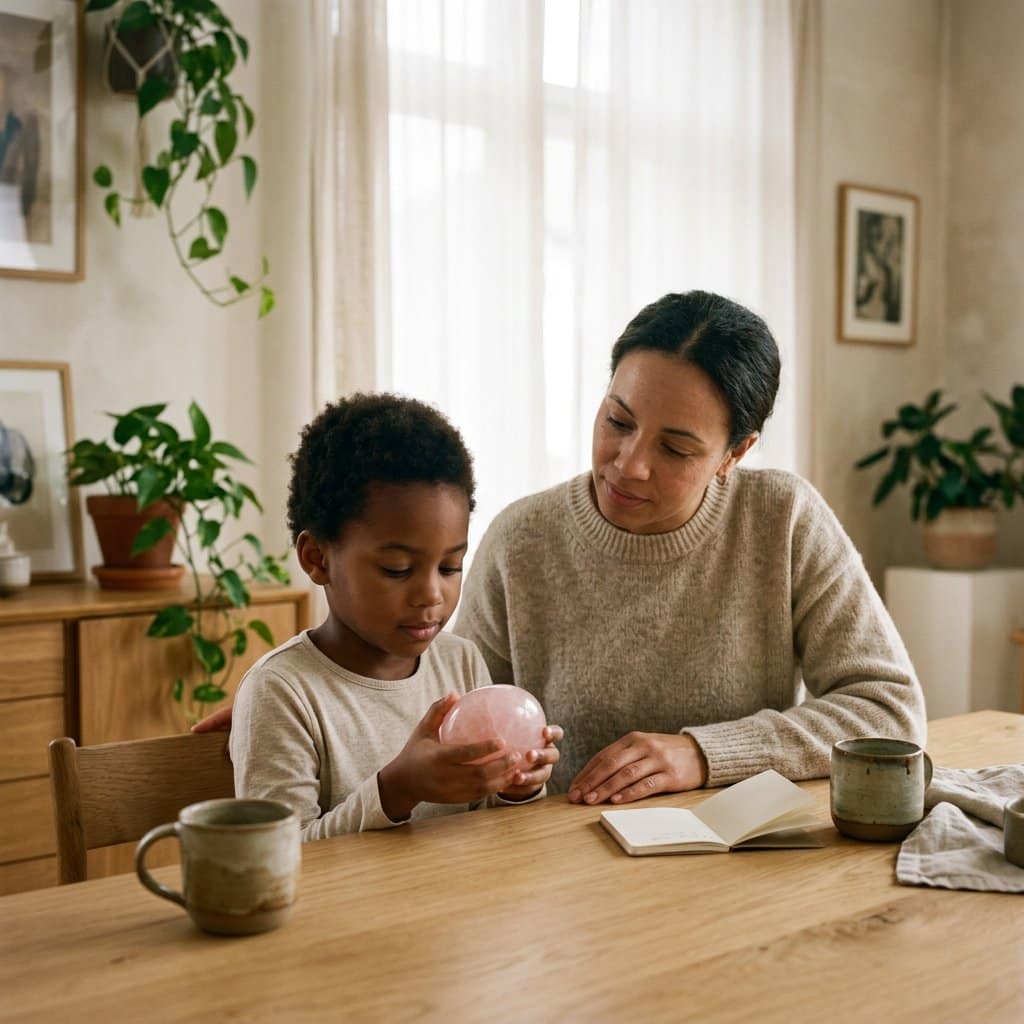

Jewellery for children: safety explained
Gemstones can be lovely for children, but safety isn’t simply a matter of whether a stone is described as “gentle” in energetic terms. For safe use with babies and children, the first consideration is a very practical one: your child’s age and stage of development, the size of the stone, how fragile it is, how you use it and whether supervision is provided. Would you like to assess how sturdy a stone is? Then read more about the hardness of gemstones.
The biggest risks are usually minor and specific: loose parts, putting things in the mouth, unsupervised use, and playing with water or in bed. For young children, a larger stone kept in a fixed place is often a safer option than a small stone to take with them, sleep with or carry around.
What you really need to look out for when making a safe choice
When making a safe choice, physical safety always comes first. A stone may be as beautiful or meaningful as you like, but if it is small, crumbles easily or gets taken everywhere, it might not be suitable for your child. Size, sturdiness, the context of use and your supervision all determine together whether a gemstone is suitable at that particular time.
There is therefore no single object, nor any fixed age limit, that is automatically safe for every child. Focus particularly on behaviour and development. Does your child still put things in their mouth? Do they handle small objects carefully? Do they understand a simple rule such as “the stone stays on the shelf” or “we only hold it together”? If the answer is still no, it’s better to choose to look at it together or to keep the stone in a fixed place.
Age, size and supervision go hand in hand
|
Developmental stage or behaviour |
What usually works |
Size, shape and supervision |
|---|---|---|
|
Babies, toddlers or children with pronounced oral behaviour |
Looking together at a stone on a shelf or cupboard out of reach |
It’s better to choose a larger, sturdy piece that stays in one place. Always keep a close eye on it; no loose stones or jewellery. |
|
Children who love to explore, but tend to forget their agreements |
Hold each other briefly during a quiet moment |
I’d prefer a rounded, slightly larger tumbled stone or pocket stone. No tiny stones, gravel bracelets or loose pieces. |
|
Children who handle small items with care |
A loose stone, either under supervision or in a fixed spot in the room |
Rounded shapes are more pleasant than sharp or brittle pieces. Supervision is still necessary, especially outside of quiet moments. |
|
Older children who understand simple rules well |
Bringing along one of your own stones might sometimes be a good idea |
It’s better to choose one solid stone than several small ones. Agree clearly on when it should be used and when it shouldn’t. |
Not every time you use it is equally sensible
- In the bedroom, a larger stone kept in a fixed place is often calmer and safer than a small stone lying loose on the bedside table.
- Small stones are more likely to get lost, break or end up being used as toys if they’re kept in a trouser pocket or pencil case. This therefore requires closer supervision and clear rules.
- Holding it together for a brief moment’s rest can work really well, precisely because you’re there and everything stays under control.
- As a decorative feature in a child’s bedroom, a stone is often the most practical choice: it’s visible, but not constantly being held or kicked about.
- It is best to avoid using it in bed, in the bath, in the mouth, in a drinking bottle or without supervision during free play. Simplicity often works best: one place or one brief moment.
Which shapes usually work best for children
- Tumbled stones: well-rounded and usually comfortable to hold. For many children, XL cuddly stones A good start, as long as the size isn’t too small.
- Pebbles: They are often slightly larger and flatter than small pebbles. They are well suited for group play or for older children who understand the rules.
- Raw pieces: often makes more sense as a facing stone than as a load-bearing stone. Do watch out for sharp edges or pieces that might crumble. Would you like to know which finish is usually safer? Read more about rough or polished gemstones.
- Clusters and geodes: They’re lovely for a permanent spot in the room. Because of their shape, they’re generally less suitable for carrying around or handling frequently.
- Crystal bags and jewellery: They require extra care, as children are more likely to open them, pull at them or lose them. For young children, a loose, visible room stone is often simpler. Would you still like them to wear something? If so, have a look at specially designed children's bracelets.
Popular stones for children, with points to bear in mind
|
Stone |
Why parents often choose these |
Practical point to note |
|---|---|---|
|
Rock crystal |
It is often chosen as an accessible stone for beginners because of its bright, neutral appearance. |
It is best to choose a smooth stone that is a good size and easy to see. Small, loose stones are less suitable for young children. |
|
Aventurine |
It is popular because of its gentle appearance and because it is often available as a lovely tumbled stone. |
A rounded shape is usually the most comfortable. For young children, it’s better to keep it in a fixed place rather than carrying it loose in a trouser pocket. |
|
Calcite |
It is often chosen for its soft or cheerful colour, depending on the variant. |
Calcite can be relatively soft. It is therefore best to handle it with care; it is not particularly suitable for rough play or for carrying around all the time. |
|
Selenite |
A popular choice due to its calm, white appearance, particularly as a stone for use in bedrooms. |
Selenite is brittle and does not tolerate water. It is best to keep it dry and leave it in a fixed spot rather than wearing it as a gemstone. |
|
Amber |
It is often chosen for its warm, light appearance and classic character. |
Extra care is needed with jewellery. Do not wear it in bed, in the bath or in the mouth, and only use it if your child can handle it safely. |
Things you’d rather avoid or only do together
- Do not give children gemstone water, and do not let them drink from bottles containing stones; see also gemstones in drinking water.
- Loose stones are not suitable for children who still put things in their mouths a lot or try to stick small objects up their noses or in their ears.
- Do not let children sleep with loose stones in their bed. There is no supervision at night, and stones are more likely to go missing – either under the child’s body or in the bedding.
- Do not continue to use stones that are damaged, splintering or crumbling. Remove them immediately if they break, or especially if they are being used as toys.
- It is best not to use stones in the bath or in any other water unless you are familiar with the stone. Some types are too soft or too fragile for this, including when cleaning and charging crystals.
How to gently introduce your child to gemstones
- Start small: one stone, one spot and one simple agreement are more than enough for a first encounter.
- Let your child take their time looking and feeling, and, if you like, choose from two or three suitable options together. That way, it stays simple and fun.
- Choose a moment that suits your child, such as holding them for a moment or placing a stone on a small shelf in the room.
- Is a single brick not quite right yet? If so, it’s better to wait a while or stick to using them together, rather than giving one away just yet.
Related articles
Orthoceras, the ancient wisdom of the Earth
Some stones carry a story that is far older than humankind. A story that can be clearly felt in the stone’s energy. The Orthoceras fossil is...
Read more

Working Together for Relaxation and Wellbeing in the Care Sector!
The Massage for Care Foundation is a wonderful initiative that we are delighted to be associated with. Thanks to our excellent relationship with the operational director, Eric Both, we have already been able to…
Read more
Koshi, discover the magic of sound and nature
A gentle breeze, the sound of rippling water or the rustling of leaves. Sound can have a special effect on you. It can take you out of your head and draw your attention...
Read more