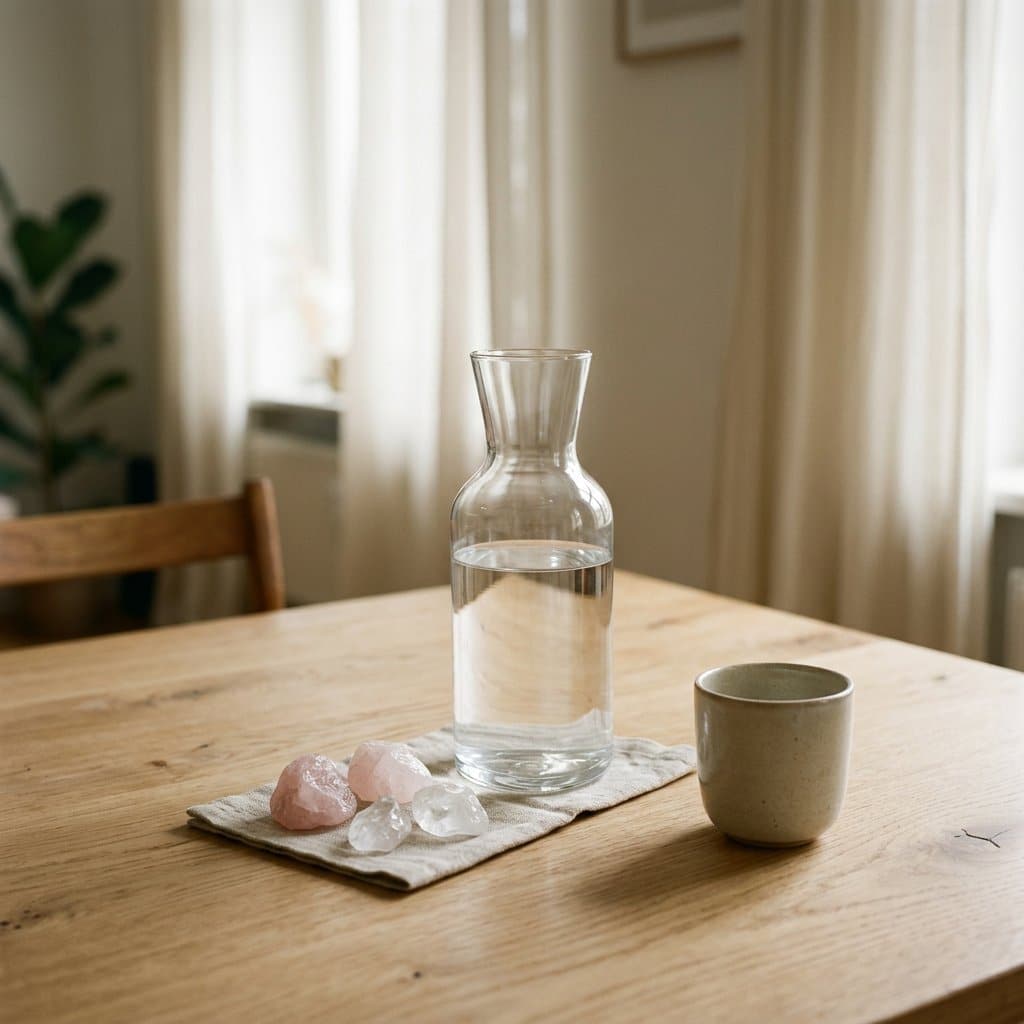

Are gemstones safe in drinking water?
Sometimes, yes, but by no means always. When using crystals, some stones are perfectly suitable for use around water, whilst others are not suitable for direct contact with drinking water. The main rule of thumb is simple: if you’re not 100 per cent sure of the exact type of stone, any treatment it may have undergone or its origin, don’t put the stone in your drinking water and opt for an indirect method instead. If you want to clear up any doubts about the type, treatment or origin, read this first Identifying gemstones.
Safe use is not just about a supposed energetic effect, but above all about the mineral composition, the condition of the stone, hygiene and the material of the bottle or carafe. A catchy brand name or a general list found online is not enough.
Quick check: this determines whether a stone is suitable
|
Checkpoint |
Why this is important |
A safe choice |
|---|---|---|
|
Is the exact type of stone known? |
The mineral composition tells you more than a brand name. |
If in doubt, avoid direct contact with the drink. |
|
Porous, soluble or metallic? |
A stone like that can leach substances into water. |
For indirect use only. |
|
Painted, glued or coated? |
It is undesirable for treatments to come into contact with drinking water. |
Do not place in water. |
|
Cracks, grit or damage? |
Loose material and dirt increase the risk. |
Stop using it immediately. |
Safe ways to use gemstones with water
There are broadly three ways to combine gemstones with water: indirectly, directly, or without drinking the water. These three methods are not interchangeable. What may be safe for one stone may, in fact, be inadvisable for another.
That is why “soaking it briefly in water” is not a general rule, and heating or boiling it is certainly not a standard safe method. As soon as you have any doubts about a stone’s composition, treatment or water resistance, indirect use is the wisest course of action. This way, you retain the ritual or symbolic aspect without taking any unnecessary risks if ingested. If you have any doubts about scratch resistance or solubility, please check the hardness of gemstones.
It is better to opt for the indirect method
- Place the stone next to your glass, bottle or carafe, rather than inside it.
- If necessary, use a sealed inner container or a separate tube to ensure that the brick does not come into contact with the drinking water.
- This is the best choice for soft, porous, painted, glued or unknown stones.
- Even in the case of indirect use, anything that does come into contact with water must be food-safe.
- Keep the bottle, carafe and any inner container clean, and dry them thoroughly after use.
Only contact us directly if you are 100 per cent sure of the type of stone
- Only opt for direct contact if the stone is untreated, water-resistant and has a known origin and clear mineral composition.
- Do not leave a stone to soak for a long time if you are not sure how it will react to water.
- Heating or boiling may pose an additional risk to both the stone and the water.
- If you notice any sediment, small cracks or cloudy water, or if you detect an unusual smell or taste, do not drink it.
- If you have any doubts about the stone, you should always stop and switch to indirect use.
- Polished stones are generally more resistant to impact than rough ones; read about the difference between rough or polished gemstones.
Want to combine several stones? Keep it simple
- Using more stones at the same time also means a greater risk of unknown reactions or contamination.
- Only combine stones that are each individually suitable for the chosen method.
- So don’t choose something purely on the basis of its supposed effectiveness or because it looks good as a combination.
- It’s best to start with a single, straightforward brick, such as one of the tumbled stones, rather than a blend whose properties you’re not fully familiar with.
- The simpler the design, the easier it is to ensure safety and hygiene.
Prefer not to drink? Here are some milder alternatives
- Place a stone next to a carafe or glass as a symbolic or ritual element, without it coming into direct contact with the water.
- Use stones when meditating, journaling or taking a moment to yourself.
- If you want to use the stone in a bath, as a spray or as a compress, make sure you pay just as much attention to hygiene and the suitability of the stone.
- Loose stones shouldn’t just be put in bathwater if you don’t know exactly how they react to water.
- This is an accessible option if you like the idea of energy but don’t want to take any risks with drinking water.
Keep water, stone and materials clean
- Use only clean stones and clean, food-safe materials. Decorative or ornamental materials are not automatically suitable for drinking water.
- Do not leave water standing for too long; change it within 24 hours.
- Clean the bottle, carafe or container thoroughly and dry everything properly before using it again.
- There is no fixed, proven standard dosage for “gemstone water”. So start with a small amount, don’t overdo it, and stop if you experience any symptoms or have any doubts.
- Would you like to find out more about a specific stone? Then take a look at our A–Z crystal pages for background information on their properties and how to look after them.
What you can and cannot expect from the way it works
When it comes to gemstones, you often come across words such as ‘energy’, ‘vibration’ or ‘support for body and mind’. Many people find this a pleasant ritual or something that helps them to consciously reflect on tranquillity, intention or self-care. Whilst this can feel personally meaningful, it is important not to automatically regard such experiences as established facts.
To the question “Has it been proven that gemstones work?”, the straightforward answer is: no, there is no scientific evidence to support any health benefits of gemstones in drinking water. You should therefore not use gemstones as a substitute for a doctor, treatment or medication. Instead, view it as a personal or spiritual choice, whilst always prioritising safety, hygiene and common sense.
Frequently Asked Questions
Which gemstones should not be exposed to sunlight?
Some stones may discolour, dry out or become more fragile when exposed to sunlight. This is distinct from drinking water safety: a stone may be sensitive to sunlight but still not tolerate direct contact with drinking water, or vice versa. You should therefore check the specific cleaning, storage and usage instructions for each type of stone. By taking care with exposure to sunlight, water and other maintenance methods, you will not only extend the stone’s lifespan but also prevent unnecessary risks during use.
What are the top 5 gemstones?
There is no objective top 5. Popularity mainly reflects personal taste and usage, not suitability for drinking water. Commonly chosen stones include, for example, rock crystal, aventurine, jasper, sodalite and carnelian. These are fine examples of well-known types of stone, but that does not automatically mean they are approved for direct contact with drinking water. Always check the exact mineral composition, the condition of the stone and the correct care instructions, rather than relying on a general ‘top list’.
How do you recharge your gemstones?
For many people, hearing Cleaning and recharging crystals as part of a care routine or ritual, but it does not alter the question of whether a stone is safe to use in drinking water. Methods such as sunlight, smoke or water are not universally suitable; what is fine for one stone may actually damage another. If a stone has come into contact with water, dry it thoroughly and check for cracks, grit or other damage before using it again, especially if it is going to be near drinking water later on.
Related articles
Orthoceras, the ancient wisdom of the Earth
Some stones carry a story that is far older than humankind. A story that can be clearly felt in the stone’s energy. The Orthoceras fossil is...
Read more

Working Together for Relaxation and Wellbeing in the Care Sector!
The Massage for Care Foundation is a wonderful initiative that we are delighted to be associated with. Thanks to our excellent relationship with the operational director, Eric Both, we have already been able to…
Read more

Koshi, discover the magic of sound and nature
A gentle breeze, the sound of rippling water or the rustling of leaves. Sound can have a special effect on you. It can take you out of your head and draw your attention...
Read more